Fixing Excess Contributions in SEP, SIMPLE, and Solo 401(k) Plans: The Complete Guide
What counts as an excess in a SEP, SIMPLE, or Solo 401(k), why the plan type decides the fix, and how to correct each one without making it worse.
Excess contributions in small business retirement plans are trickier than the IRA version, because there isn't one fix. A SEP, a SIMPLE, and a Solo 401(k) each correct differently, and the type of excess inside each one changes the path again. This guide walks all three start to finish: what counts as an excess, why the plan wrapper decides the correction, how SEP, SIMPLE, and Solo 401(k) excesses each get fixed, the forms that show up, and the point where it stops being a do-it-yourself job.
What Counts as an Excess in a Small Business Retirement Plan
With an IRA, an excess contribution is essentially one kind of problem with one correction system, which the IRA excess guide covers in full. Small business plans are messier. There are more moving parts and more ways for a contribution to end up somewhere the rules don't allow. If you are not yet certain the money landed in a plan rather than a personal IRA, the free IRA excess contribution check settles that question in a few minutes before you pick a correction path.
It can come from the employer side, where the business contributes more than the plan or the tax code permits. It can come from the employee side, where a salary deferral runs past the annual deferral limit. It can come from using compensation above the annual limit the IRS sets for figuring contributions. It can be an annual additions problem, where everything going into one person's account in a single year adds up past the ceiling. It can be a deduction problem, where the business put in more than it can deduct for the year, which is its own kind of trouble even when the contribution itself may have been allowed under the plan. It can be a timing problem, a contribution landing in the wrong plan year or tax year. It can come from plans interacting, when someone has more than one and the limits have to be read together. And it can be as ordinary as a payroll, W-2, or recordkeeping error that misstated what actually went in.
That range matters, because it sets up everything else in this guide: "excess" in a small business plan is not a single diagnosis. An over-deferral is a different problem than a nondeductible employer contribution, which is a different problem than blowing the annual additions limit. They get reported differently, corrected differently, and carry different consequences.
So the first job isn't to fix anything. It's to identify which kind of excess you have, and in which plan, because that pairing, the type of excess and the plan wrapper it happened in, decides everything that follows. That's the next section.
Why the Plan Type Changes Everything
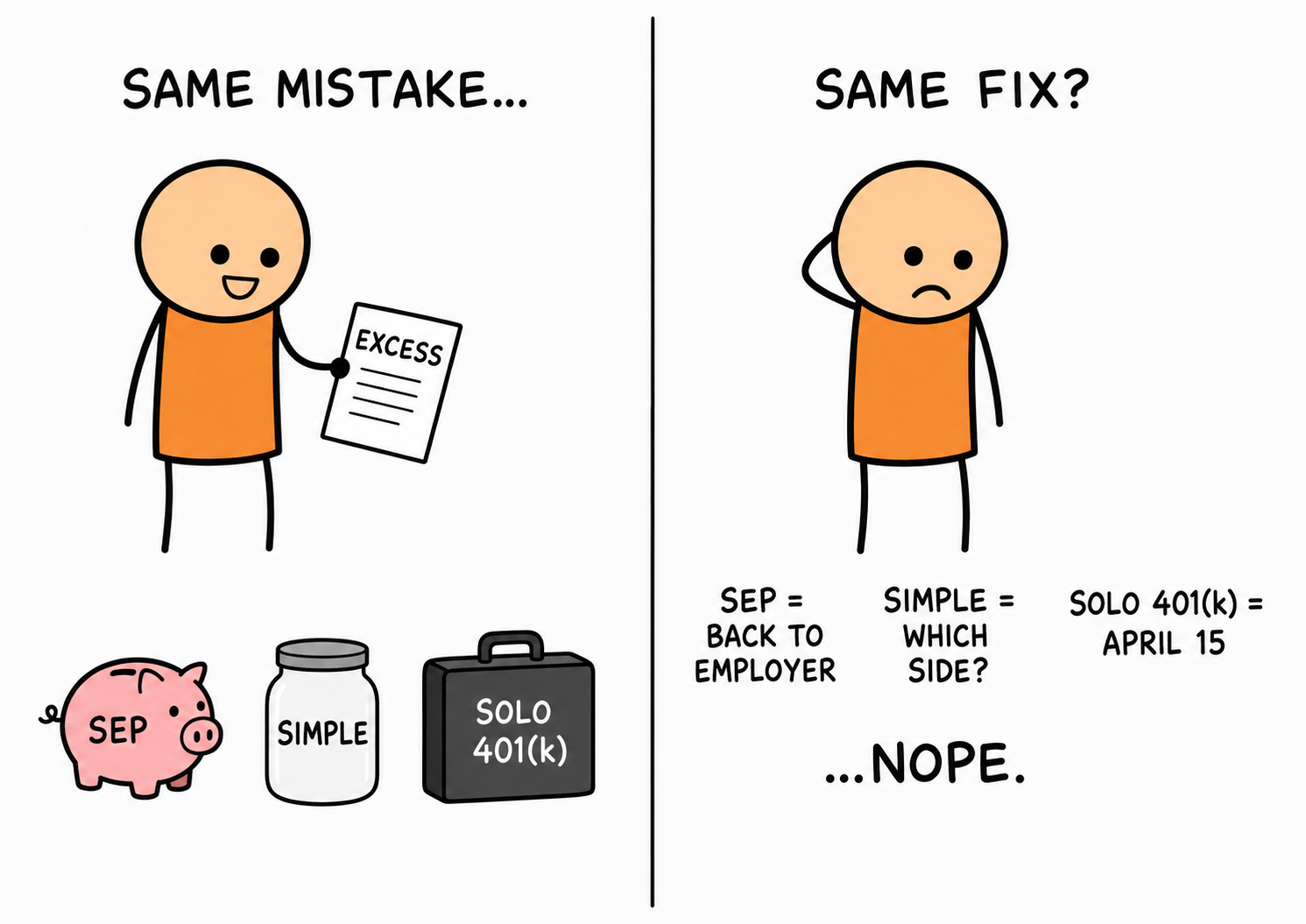
The single most useful thing to understand about a small business plan excess is that the plan wrapper, not the dollar amount, decides how you fix it. The same $5,000 over-contribution gets handled three different ways depending on whether it landed in a SEP, a SIMPLE, or a Solo 401(k). Get the plan right and the correction path follows. Get it wrong and you can apply the wrong fix to the wrong problem.
There are really two families here.
SEP IRAs and SIMPLE IRAs are IRA-based. The money sits in an IRA, so some of what you know about personal IRA excesses carries over, including the 6% excise tax that can apply for each year an excess stays in the account. That familiarity is useful, but it's also a trap, because these are not personal IRAs. They're employer plans built on an IRA chassis, which means there's a whole business-side layer the personal IRA rules never touch: deduction limits on the company, excise taxes that can fall on the employer rather than the individual, and corrections that may have to run through the business, not just the account holder. So the 6% framing from the IRA guide is a starting point for SEP and SIMPLE, not the whole answer.
Solo 401(k)s are a different universe. A Solo 401(k) is a qualified plan, not an IRA, and the entire correction system changes with it. There's no IRA-style 6% excess-contribution excise to reach for. Instead you're in the world of elective deferral limits and annual additions limits, a hard April 15 deadline for fixing excess deferrals, the risk of the same dollars being taxed twice if you miss it, and formal IRS correction programs for plan-level failures. The personal IRA correction playbook does not carry over. Treating a Solo 401(k) excess like an IRA excess is one of the most common and most expensive mistakes in this area.
That's why the next three sections are split by plan. The type of excess tells you what went wrong. The plan tells you how it gets fixed.
SEP IRA Excess Contributions
A standard SEP is funded by employer contributions, not employee salary deferrals. That means a SEP excess is almost always one thing: the business put more into someone's SEP-IRA than the rules allow. That usually traces back to contributing above the percentage-of-compensation limit, going over the annual dollar cap, counting compensation above the IRS limit, or simply using the wrong definition of compensation in the math.
Here is where being IRA-based stops looking like a personal IRA. You don't just withdraw the excess to yourself. Under the IRS correction methods, the excess plus its earnings comes out of the employee's SEP-IRA and goes back to the employer, not to the employee. The corrective distribution is generally not taxable to the employee, reported on a Form 1099-R with a taxable amount of zero. The business, meanwhile, doesn't get to deduct the excess it put in. That round trip, money flowing back to the company rather than the individual, doesn't happen with a personal IRA, and it's why you can't run a SEP correction on IRA instincts alone.
There is a second path. Instead of pulling the excess out, the plan can ask to leave it in the SEP-IRA, but only through a formal filing with the IRS, a closing agreement, and a sanction of at least 10% of the excess. That's the route when removing the money isn't practical, and it's squarely professional territory.
Leaving it alone is the expensive option. Depending on the failure, an uncorrected excess or nondeductible contribution can draw a 10% excise on the business, while an excess left in the IRA may also trigger the individual 6% excise tax. Two separate taxes, two separate sides, both recurring until it's fixed.
If the failure qualifies, the cleaner distribution method can often be self-corrected without an IRS filing. Which option fits depends on the size of the excess, how it happened, and how long it has been sitting, which is a conversation for your plan provider or a TPA, not a DIY afternoon.
SIMPLE IRA Excess Contributions
A SIMPLE IRA is fed from two sides, not one. The employee defers part of their pay, and the employer adds a match or a flat contribution on top. That means a SIMPLE excess can come from either side, and which side it came from changes the fix. This is the wrinkle a SEP doesn't have.
Start with the employee side. Salary deferrals are capped, both by the SIMPLE deferral limit and by the overall individual deferral limit that applies across every plan you pay into. Defer past that and you have an excess deferral. The clean fix is to take the excess out, with its earnings, by April 15 following the calendar year of the excess deferral. Done on time, the deferral is taxed in the year you made it and the earnings in the year they come out, and you avoid the bigger mess. Miss that window and the problem changes shape: because the money is sitting in an IRA, the excess can become an excess IRA contribution subject to the same 6% that haunts a personal IRA, and pulling it out later before 59½ can add an early-distribution tax on top. For SIMPLE IRAs, that early-distribution tax can be even higher during the first two years of participation.
The employer side works more like a SEP. If the business contributes more than the plan document and annual notice call for, the excess plus earnings may need to be distributed under the IRS correction method, or handled through the retention method. The business generally does not get a deduction for the overage. Very small overages may qualify for de minimis relief, depending on the correction method and facts.
So a SIMPLE excess is really two questions stacked together: which side overflowed, and how fast you caught it. An over-deferral caught by the deadline is a clean fix. An employer miscalculation may run through the plan-correction system. And anything left to sit drifts toward the 6% IRA world the longer it goes. As with SEP, the messier versions belong with a plan provider or TPA, not a weekend spreadsheet.
Solo 401(k) Excess Contributions
A Solo 401(k) is a qualified plan, and that single fact rewires everything. There are two separate limits you can blow, they fail in two different ways, and neither one is fixed like an IRA excess. If you take only one thing from this guide, take this: do not treat a Solo 401(k) over-contribution as something you can quietly pull out of an account. The rules are stricter and the clock is harder.
The first limit is on your salary deferrals, the money you put in as the employee. Go over it and you have an excess deferral, and the deadline to fix it cleanly is firm: April 15 following the year of the deferral. Not your extended return due date, not October, April 15. Meet it and the fix is usually much cleaner. The excess comes out with its earnings, the deferral is taxed in the year you made it, the earnings in the year they come out, and there is generally no 10% early-distribution penalty, no 20% mandatory withholding, and no spousal consent requirement on a timely corrective distribution. Miss it and you walk into the most expensive trap in this guide: the excess gets taxed twice, once in the year you deferred it and again in the year it finally comes out, and correcting late through the IRS programs does not erase that double hit. The April 15 deferral deadline is the one date here you do not want to discover after the fact.
The second limit is on total annual additions, everything that landed in your account for the year added together: your deferrals, the employer profit-sharing contribution, any after-tax money. As the owner you fund both sides, so it's easy to stack past this ceiling without noticing. Blowing it is a plan-level failure, not a personal one, and it gets corrected through the formal IRS plan-correction system, which generally distributes or forfeits the excess using IRS correction ordering rules, often starting with after-tax money, then elective deferrals, then employer contributions, until the account is brought back under the limit. What comes back out is taxable in the year it's distributed, again with no 10% penalty.
So a Solo 401(k) excess is never "remove it like an IRA." It's either a hard April 15 deferral deadline with a double-tax cliff behind it, or a plan-correction matter with its own ordering rules. Both are worth a call to your plan provider or a TPA before you touch anything, especially once April 15 has passed.
The Forms That May Enter the Conversation
As with the IRA side, which forms you touch depends on the plan and the correction path you take. Think of these as a map of where a small business plan excess shows up on paper, not a checklist to work through.
Form 5330 is the employer's excise-tax return. It's where the business reports and pays the excise taxes that fall on the company rather than the individual, including the 10% tax on nondeductible contributions that an over-funded employer plan can trigger. It's the employer-side counterpart to the individual's 6% form, and it's filed by the plan sponsor, not the participant.
Form 1099-R reports the money coming back out. A corrective distribution, whether it is a returned SEP excess, a withdrawn excess deferral, or a distribution tied to an annual-additions correction, may be reported on Form 1099-R, with a distribution code that tells the IRS what kind of correction it was. Some carry a taxable amount, some carry zero, depending on the plan and the method. You don't create this one. The plan or custodian issues it, the codes matter, so it's worth reviewing with your preparer.
Form 5329 is the individual's 6% excise form, the same one from the IRA guide. It comes into play on the SEP and SIMPLE side, because those are IRA-based, when an excess stays in the account and draws the 6%. It does not apply to a Solo 401(k), which has no IRA-style 6% to report. For the full breakdown, see the Form 5329 guide.
If a correction runs through the IRS voluntary correction program rather than a simple distribution, that route is its own filing, made by the plan on forms like 8950 and 14568, and it's firmly plan-professional territory. And separately, when the real problem was a payroll or reporting error, cleaning it up can involve a corrected W-2, because the original numbers, not just the account balance, were wrong.
The point is the same as before: you don't need to master these here. You need to recognize which ones your situation pulls in, so that when a 5330 or a 1099-R shows up, you know why, and you know which is the business's job and which is yours.
Tricky Situations
This is where small business plan excesses get genuinely tangled, and where the cost of guessing climbs. The patterns that come up most:
You wear both hats. In a SEP or a Solo 401(k), the owner is both the employer and the employee. You control both contribution levers and there's no payroll department to catch a mistake, which makes over-contributing easy and self-policing hard. It also makes some corrections feel strange: when a SEP correction sends the excess "back to the employer," the employer is you.
The two-plan deferral trap. The salary-deferral limit is an individual limit, added up across every plan you defer into, not a per-plan limit. So someone with a Solo 401(k) on the side and a regular 401(k) at a day job can stay under the limit in each plan and still blow it on the combined total. Here's the part that stings: the clean late-correction path through the IRS programs is built for a single plan that failed, not for an individual who over-deferred across two unrelated employers. Catch that across-plan excess by April 15 and you may be able to ask one of the plans to distribute the excess, depending on the plan's procedures. Miss April 15 and there may be no clean tax fix at all, just the double-tax result when the excess is eventually distributed. This one blindsides high earners with a side business.
Stacking deferrals on top of profit-sharing. Because you fund both sides of a Solo 401(k), it's easy to max your deferrals and then add an employer profit-sharing contribution that pushes the total past the annual additions ceiling. That's a different problem than a pure over-deferral, and it gets corrected differently.
More than you can deduct is not the same as more than you can contribute. A business can contribute an amount that's allowed under the plan but more than it can deduct for the year. That's a deduction problem with its own excise exposure, not necessarily an excess annual addition. Same trap as the nondeductible-versus-excess confusion on the IRA side, just on the employer's books.
The self-employment math. For a self-employed owner, contributions are based on net earnings from self-employment, after specific adjustments, not on gross revenue or plain Schedule C profit. Run the contribution off the wrong number and you can over-fund without realizing it. This is one of the most common ways a solo owner ends up with an excess in the first place.
It sat for years. Like an IRA excess, a small business plan excess left alone doesn't just wait politely. Depending on the plan, it can stack a recurring 6% on the individual, a recurring employer excise on the business, and a harder plan-correction the longer it runs.
The system let me do it. Payroll and recordkeeping platforms often don't enforce the total annual additions limit or the across-plan deferral limit. The contribution going through cleanly tells you the software allowed it, not that the rules did. That part is on you to watch, not the platform.
When two or more of these are in play at once, you're well past a DIY fix, which is the next section.
When to Stop DIYing
The honest truth about small business plan excesses is that the DIY zone is narrow. There's a real one: a single, clearly identified excess caught early, a deferral you can pull before April 15, a modest SEP over-contribution you spot the same year, where you and your plan provider can handle it cleanly. But the cases that stay simple are the exception, not the rule, and the line into professional territory comes up fast.
Cross it the moment a deferral fix slips past April 15, because you're now in double-tax and plan-correction territory, not a quiet withdrawal. Cross it when the problem is a total annual additions failure, because that's a plan-level issue corrected through the IRS programs with their own ordering rules. Cross it when an employer excise tax is in play, since that means a Form 5330 and a question of what the business owes, separate from the individual. Cross it when more than one plan or more than one year is involved, when the deduction and excise pieces start interacting, or when you simply can't tell which limit you blew. And cross it for anything heading toward a voluntary IRS filing, which is a formal submission with a fee, not a form you dash off.
Even self-correction is more of a process than people expect. SECURE 2.0 broadened it: the old fixed EPCRS self-correction window for many significant failures has been replaced by a broader reasonable-time standard for eligible inadvertent failures. In general, the plan has to begin correction before the IRS identifies the failure, complete it within a reasonable period after discovery, and the failure cannot be egregious, abusive, or tied to diversion or misuse of plan assets. Under interim IRS guidance, the exact contours are still being settled, which means the self-correction rules are themselves a moving target. That alone is reason to have someone who tracks this confirm where you stand.
The people who do this work, a TPA, an ERISA-savvy CPA, a plan administrator, aren't a fallback for when you've failed. They're the right tool for a job that was never designed to be done alone, given how the plan documents, the excise rules, and the correction programs all fit together. The cost of getting it right is almost always smaller than the cost of a wrong correction, which here can mean double taxation, recurring excise, or a threat to the plan itself. So the rule is simple: identify what you have, and the moment the picture gets messy, make this a conversation with a professional rather than a project you take on alone.
Start With the Small Business Excess Contribution Fix Tool
By now the through-line should be clear: a small business plan excess isn't one problem with one fix. It's a plan question first and a dollar question second. SEP, SIMPLE, and Solo 401(k) each correct differently, and the type of excess inside each one changes the path again. That's a lot to hold in your head when you're staring at a contribution you think went too far.
So don't start by guessing. Start by figuring out which plan you're in and which kind of excess you actually have, because everything downstream depends on that pair. The Small Business Excess Contribution Fix Tool is built for exactly these three plans. It helps you sort the plan type, the contribution type, and whether an excess may need review before you decide what to do next, so you're not trying to self-diagnose from a general article.
If what you have is a cleaner, in-window correction, the tool can help you organize the next steps. If it's one of the messier cases this guide walked through, an excess past the April 15 deferral deadline, a total annual additions failure, anything involving the employer excise or a voluntary IRS filing, the tool will help you see that clearly, which is exactly when you take what you've learned here to a TPA or an ERISA-savvy CPA.
Either way, the move is the same as it was for the IRA side. Find out what you're actually dealing with before you touch anything, because in small business plans more than anywhere else, the wrong correction can cost more than the original mistake. If the excess turns out to sit in a personal IRA after all, the IRA fix tool will walk through the correction steps for your situation instead.
Run the numbers on your situation
Tools built for the exact situations this guide covers.
Frequently Asked Questions
What counts as an excess contribution in a SEP, SIMPLE, or Solo 401(k) plan?
It depends on the plan and the limit you crossed. It can be an employer contribution above what the plan formula or the IRS limits allow, an employee salary deferral above the annual deferral limit, a contribution based on the wrong compensation figure, or total contributions that exceed the annual additions ceiling. The plan type and which limit you blew determine how it gets fixed, so the first job is identifying both.
How do I correct an excess SEP IRA contribution?
A standard SEP holds only employer contributions, so an excess is usually the business's to fix. There are generally two routes: distribute the excess plus earnings, which generally goes back to the employer under the IRS correction method and is generally not taxable to the employee, or keep the excess in the plan and use the IRS retention method, which involves a formal filing and a sanction. Leaving it uncorrected can draw a recurring employer excise tax and, on the IRA side, the recurring 6% excise.
What is the deadline to fix an excess Solo 401(k) salary deferral?
April 15 of the year following the deferral. Meet it and the correction is usually much cleaner: the excess and its earnings come out, the deferral is taxed in the year you made it, and the earnings are taxed when distributed, generally with no 10% early-distribution penalty. Miss it and the excess can be taxed twice, once in the deferral year and again when it is eventually distributed, and correcting late does not erase that double-tax result.
Does a SEP or SIMPLE excess trigger the 6% penalty like an IRA?
It can, because SEP and SIMPLE plans are built on IRAs. An excess that stays in the account can draw the same 6% excise that applies to a regular IRA excess, reported by the individual on Form 5329. A Solo 401(k) is different. It is a qualified plan rather than an IRA, so it has no IRA-style 6% excise, and its excesses are handled through the plan-correction system instead.
Can I create an excess by contributing to two retirement plans?
Yes, and it is a common surprise. The salary-deferral limit is an individual limit added up across every plan you defer into, not a separate limit per plan. Someone with a Solo 401(k) on the side and a 401(k) at a regular job can stay under the limit in each plan and still exceed it on the combined total. Catching that by April 15 matters, because the clean correction path is much harder once the issue is an across-plan individual deferral problem rather than a single plan error.
Is a nondeductible business contribution the same as an excess contribution?
Not necessarily. A business can contribute an amount that is allowed under the plan but more than it can deduct for the year. That is a deduction issue with its own excise exposure, which is different from contributing more than the plan or the law actually permits. They can overlap, but they are separate problems with separate fixes, which is why pinning down which one you have matters.
What forms come into play when fixing a small business plan excess?
It depends on the plan and the correction. Form 5330 is the employer's excise-tax return for taxes that fall on the business. Form 1099-R reports money distributed out of the plan as part of a correction. Form 5329 may report the individual 6% excise on the SEP and SIMPLE side when an IRA-based excess remains. A voluntary IRS correction filing has its own paperwork, handled by the plan. You usually do not need to master these yourself, but recognizing which ones your situation pulls in helps you ask the right questions.
Do I need a TPA or CPA, or can I fix it myself?
The do-it-yourself zone is narrow. A single, clearly identified excess caught early can sometimes be handled with your plan provider. But once a deferral fix slips past April 15, an annual additions limit is involved, an employer excise tax or a voluntary IRS filing is in play, or more than one plan or year is affected, this becomes professional territory. A TPA or an ERISA-savvy CPA is the right tool for that job, and the cost of getting it right is usually smaller than the cost of a wrong correction.
Related Guides
Education-only disclaimer
This guide is for general education and information only. It does not provide individualized investment, tax, or legal advice, and does not establish a client relationship with any firm or individual. Always consult your own tax professional, financial advisor, or legal counsel before making decisions about your accounts, investments, or retirement strategy.
Get the retirement rule mistakes most people learn too late
Daily: one retirement rule trap, why it happens, and the fix. Everyday-language IRS rule breakdowns from an 8-year Schwab/TD Ameritrade veteran. Free.
Join the Rundown, Free