Fixing Excess IRA Contributions: The Complete Guide
What counts as an excess contribution, the deadline that decides your options, every way to correct it, and the traps that turn a small mistake into a recurring one.
Excess IRA contributions are one of the most common retirement-account mistakes, and one of the most misunderstood. The rules that create them are easy to trip, the fix changes completely depending on when you catch it, and the wrong correction can cost you more than the original mistake. This guide walks the whole thing start to finish: what counts as an excess, the deadline that decides your options, every correction path, the forms involved, and the situations where it stops being a do-it-yourself job.
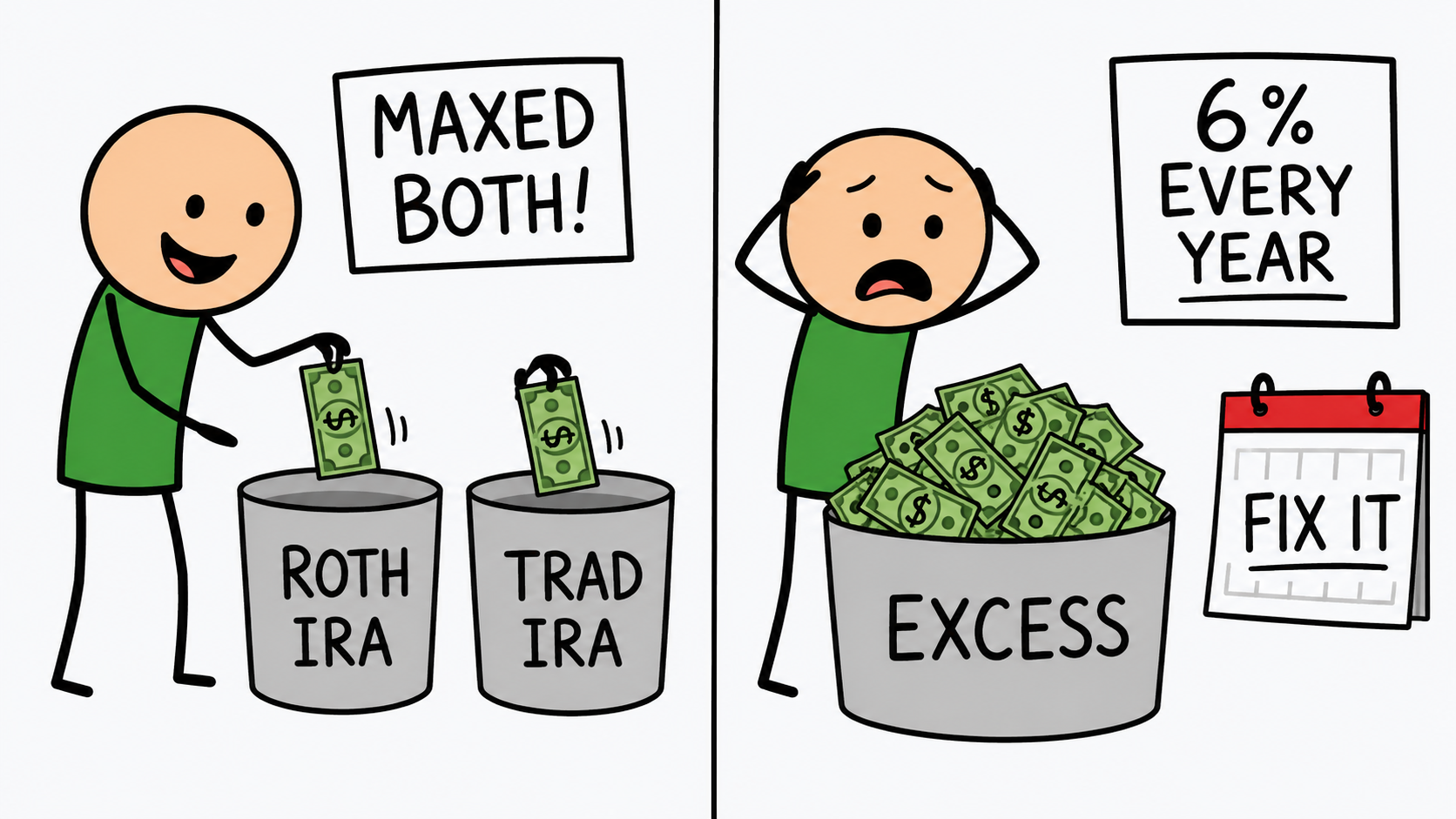
What Counts as an Excess IRA Contribution
An excess contribution is money that landed in your IRA that the rules never allowed in. It doesn't matter that the deposit cleared, that your custodian accepted it, or that it felt right at the time. If it was more than you were eligible to contribute, the IRS treats the overage as excess, and a recurring penalty starts running until you fix it.
A handful of situations create one. You contributed more than the annual limit. You contributed more than your taxable compensation allowed. You put money in a Roth when your income was too high to allow some or all of it. You contributed with no eligible compensation at all. Or a contribution got coded to the wrong year and tipped that year over its limit.
The one that catches people most often is the limit itself, because it isn't what most people picture. The annual IRA limit is a single combined ceiling across your Traditional and Roth IRAs together, not a separate allowance for each. Fund a Roth up to the max and then add "just a little" to a Traditional, and that second contribution can be entirely excess even though each account looked fine on its own. For more on this, see what actually makes an IRA contribution excess.
Two more worth naming. Your contribution can't exceed your taxable compensation for the year (or your spouse's, if you're using a spousal IRA), so a year with little or no earned income caps you far below the headline number, sometimes at zero. And Roth eligibility phases out as income climbs, so a raise, a bonus, a large capital gain, or a better-than-expected income year can quietly push you past the line on a contribution you already made.
None of these takes bad intent. Most excess contributions are made by careful people who simply hit a rule they didn't know applied to them. What you do about it depends on which rule you hit and how fast you catch it, which is where the rest of this guide goes.
One scope note before that. Everything here covers personal Traditional and Roth IRA contributions. Money that went in through a workplace plan follows a different correction system, so if the overage sits in a SEP, a SIMPLE, or a Solo 401(k), start with the guide to small business plan excess contributions, then let the small business version of the fix tool walk through the correction steps for your situation.
What Is Not Necessarily an Excess Contribution
Before you fix anything, make sure you actually have a problem, because the most common false alarm in this whole area is mistaking a nondeductible contribution for an excess one. They are not the same, and the difference decides whether you may have a penalty problem or a reporting problem.
An excess contribution is money you weren't allowed to put in. A nondeductible contribution is money you were allowed to put in but can't write off on your taxes. One is a problem that triggers the 6%. The other may be allowed, but it has to be reported correctly.
With a Roth, high income can make the contribution itself partly or fully off-limits, so going over the line can create an actual excess. With a Traditional IRA, there is no income limit on whether you can contribute at all, only on whether you can deduct it. So a high earner covered by a workplace plan may still be able to contribute to a Traditional IRA, assuming the taxable compensation and annual limit rules are satisfied, even if none of it is deductible. Same "my income is too high" feeling, two completely different outcomes. You can check the current contribution limits and MAGI phase-outs to see where you land.
The stakes are real. If you decide your nondeductible Traditional contribution is "excess" and yank it back out to fix it, you've pulled money out for no reason, possibly triggered tax on the earnings, and lost a contribution you were entitled to make. The correction created the damage.
A nondeductible contribution doesn't need fixing. It needs recording. You file Form 8606 to log the basis, so that years from now, when you take the money out, the IRS knows that portion was already taxed and doesn't tax it again.
So before you read another word about correction paths, settle the threshold question: did you contribute more than you were allowed to, or just more than you could deduct? Only the first is an excess contribution. If it's the second, you're not here to fix a penalty, you're here to file the right form.
Why Fixing Matters: The Recurring 6% Excise Tax
An excess contribution isn't a one-time mistake you can shrug off. Left in the account, it gets hit with a 6% excise tax for every year it stays there. Not once. Every year, until you clear it.
Six percent doesn't sound like much, and in any single year it isn't. The damage is in the repetition. Say you leave a $1,000 excess in the account for three years. That isn't a one-time $60 problem. It's $60 a year, three years running, charged again each December 31 the money is still there, and that's before you've dealt with the correction itself. The numbers are just an illustration, but the pattern is the point: the cost is the repetition, and excess contributions are very good at going unnoticed.
That's the trap. Nobody sends you a bill. The 6% is self-reported on Form 5329, which means if you don't know you have an excess, nothing stops you from quietly racking up the tax year after year while your return looks fine. The IRS isn't reminding you. Your custodian isn't either.
The tax is figured on the excess amount, capped at the value of your IRAs at year-end, so a sharp market drop can lower it. Don't count on the market to bail you out.
Here's the part that should motivate you: the 6% is almost entirely avoidable. Fix the excess properly by the correction deadline, and the 6% tax may never apply at all, not even for the first year. Miss that deadline and it applies for that year and keeps applying until you remove or absorb the excess. Which deadline, and which fix, is the next thing to sort out.
The Deadline That Decides Your Options
Almost everything about fixing an excess comes down to one date: the deadline for a timely correction. Beat it, and the cleanest fixes are on the table and the 6% can be avoided entirely. Miss it, and your options narrow to the slower, more form-driven kind, with the 6% already on the meter.
The usual timely-correction deadline is the due date of your tax return for the year of the contribution, including extensions. There is also a special automatic six-month window that people often miss. If you timely filed your return without correcting the excess, IRS guidance generally allows you to have the contribution returned within six months of the original return due date, excluding extensions, and then file an amended return with the required notation. In practice, for many calendar-year taxpayers, that can create a correction window that runs to October 15 of the following year, but the mechanics are not something to eyeball.
That window is also conditional. The automatic relief depends on having filed timely, the exact date shifts with weekends, holidays, and the occasional disaster-relief postponement, and the amended-return and notation rules have to be followed correctly. Because so much of this turns on your specific facts, confirm it against the current Form 5329 instructions or with your tax preparer before you rely on a date.
What the deadline buys you is the subject of the next section. Before it, you may be able to withdraw the excess along with its earnings or recharacterize the contribution, and a proper timely correction generally avoids the 6% entirely. After it, those doors mostly close and you're working with what's left: absorbing the excess into a later year, or simply removing it to stop the bleeding while paying the 6% for the years it already sat there.
So before anything else, place yourself on the timeline. Are you still inside the correction window, or past it? That one answer decides which of the next section's paths is actually yours.
Your Correction Paths
Which fix is available to you depends on where you landed on that timeline. Inside the correction window you have the clean options. Past it, you're choosing among the cleanup options. Here's the full set.
Before the paths themselves, a quick illustration of why the date matters so much. Say you over-contributed $3,000. Catch it inside the window and you can take that $3,000 out with its earnings, or recharacterize it, and the 6% never starts. Catch the same $3,000 two years late and it has already drawn the 6% for two years, the clean options are gone, and you're down to removing the principal or absorbing it later. Same mistake, same dollars, a completely different fix, decided entirely by when you found it. (Round numbers, for illustration.)
If you're still inside the window, two paths can keep the 6% from ever starting.
Withdraw the excess plus its earnings. You take out the excess amount along with the net income attributable to it, the gains or losses that money generated while it sat in the account. Done properly and on time, this is the cleanest fix, and it generally avoids the 6% entirely. The earnings get their own tax treatment, which the next section covers.
Recharacterize the contribution. If the money was eligible somewhere and just parked in the wrong type of account, recharacterization treats it as if you had originally made it to the other IRA type instead. A common case is a Roth contribution your income disqualified, recharacterized as a Traditional contribution. This has to happen inside the window.
If you're past the window, the 6% has already applied for the year or years the excess sat there, and the goal shifts to stopping the bleeding.
Remove the excess. You remove the excess amount itself to stop it from sitting in the account at year-end. After the timely correction window has closed, this is generally not the same as a return of excess plus NIA. You are usually trying to remove the stranded excess so the 6% does not keep applying in future years, while dealing separately with any 6% tax that already applied for prior years. The tax treatment and reporting can depend on the account type, whether the contribution was deducted, and your Form 5329 history.
Absorb it into a later year. If you have unused contribution room in a year you're eligible, the stranded excess can count as that year's contribution and use itself up. It works, but the 6% still applies for every year the excess remained before it got absorbed.
Leave it and keep paying. Doing nothing is technically a path. It's just the one that keeps charging you 6% every year the money stays put.
This is educational, not a recommendation for your situation. Which path actually fits depends on your facts, your deadline, and your account type, so work it through with your custodian and a tax professional before you act. Start by checking your situation with the IRA Excess Contribution Check, and for the correction math on a Traditional or Roth excess, the Excess Contribution Fix Tool.
The NIA Calculation
When you correct an excess by the deadline, you don't just pull out the dollar amount you over-contributed. You generally must also remove the net income attributable to it, the NIA, which is the earnings or losses that money generated while it sat in the account. The goal is to leave the account looking as if the excess contribution had never been made.
Two things surprise people about how it's figured. First, it's based on the performance of the whole account over the period, not on whatever specific fund or stock you happened to buy with the excess. Second, it can be negative. If the account lost ground while the excess was in it, the NIA is a loss, and you actually remove less than you put in. The earnings move with the account, in both directions.
You usually won't run this calculation yourself. For a timely return of excess, the custodian typically computes the NIA from the account's own data and distributes the right amount. You can provide your own figure in some cases, but the custodian's number is the one that ends up on the tax forms, so it's worth having them do it or confirm it.
The tax treatment is where a lot of still-current advice is out of date. The NIA earnings are taxable, included in income for the year the contribution was made. But the old rule that those earnings also caught the 10% early-distribution penalty if you were under 59½ is gone. SECURE 2.0 removed that penalty for earnings returned as part of a timely excess correction. So today, on a timely IRA excess correction, the earnings are generally taxable, but they are not hit with the federal 10% early-distribution penalty just because you are under 59½. A surprising number of articles and even advisors still cite the old 10% hit, so if someone tells you the earnings get penalized, check the date on their information.
The calculation itself is mechanical once you have the inputs, which is exactly what the Excess Contribution Fix Tool is built to handle.
The Forms
Which forms you touch depends entirely on which path you took, so think of these less as a checklist and more as a map of what shows up where.
Form 5329 is the excess-contribution form. It's where the 6% excise tax gets calculated and reported, Traditional IRA excess in Part III and Roth IRA excess in Part IV, so it comes into play whenever an excess actually sat in the account for a year and the tax applies. If you fixed everything timely and the 6% never triggered, you may not touch it at all. If you didn't, this is the form that does the math.
Form 1099-R reports the distribution. When you remove an excess, timely or not, the custodian issues a 1099-R showing money came out, with a distribution code that tells the IRS what kind of distribution it was. You do not create this one. It arrives from the custodian, and you review it with your tax preparer to make sure it lines up with what actually happened.
Form 8606 is the basis form. It matters when nondeductible contributions are in the picture, the case from earlier where money was allowed in but never deducted. It is how you track the already-taxed portion of your IRA so you are not taxed on it twice later. Form 8606 does not fix an excess by itself. It records basis when a contribution was allowed but not deductible.
Form 1040-X is the amended return. It may enter when you had already filed and then made the correction afterward, which is common with the automatic six-month window. You amend to reflect the correction, any taxable earnings, and any related changes that belong on the return.
That's the whole cast. The point isn't to learn how to fill them out here, it's to recognize which ones your situation pulls in, so that when your custodian or preparer mentions a 5329 or hands you a 1099-R, you already know why. The actual filing is worth doing with a tax professional, especially once more than one of these is in play.
Tricky Situations
This is where excess contributions stop being simple, and where most generic articles either go vague or get it wrong. The patterns that come up most:
Multi-year excesses. An excess that goes unnoticed doesn't just sit there, it compounds the paperwork. Each year it remained is its own 6% charge and, often, its own Form 5329. Catching one excess can mean reconstructing several years at once, and the cleanup gets harder the longer it ran.
You already filed your return. Filing before you fixed the excess doesn't close the door, but it changes the route. If you're inside the automatic six-month window, you can still correct and then amend to reflect it. The timing and the notation rules matter here, which is why this is one to walk through with a preparer rather than wing.
You already pulled the money out. People often "fix" an excess by withdrawing it before they understand which method applies, the timely return-of-excess that requires removing the NIA, or a post-deadline removal that doesn't. What you actually did, and when, determines how it gets reported, so the order of events matters more than the simple fact that money came out.
The account lost money. A loss while the excess sat there isn't bad news for the correction. Because the NIA can be negative, a timely fix on a losing position means you remove less than you put in. The math works in your favor, but only if it's calculated correctly.
Roth phase-out surprises. A raise, a bonus, or a better-than-expected income year can retroactively make a Roth contribution you already made partly or fully ineligible. You can land over the line without doing anything differently, which is why this one blindsides careful people.
Backdoor Roth confusion. A backdoor Roth is a nondeductible Traditional contribution followed by a conversion. Done correctly, and assuming the Traditional IRA contribution itself was allowed, none of it is an excess. The confusion comes when people mistake the steps, or the pro-rata rule's tax result, for an excess problem when it isn't one.
Basis and Form 8606. When nondeductible money is in the mix, your basis has to be tracked correctly through the correction, or you risk being taxed twice on the same dollars later. This is the thread that ties an excess fix to your long-term records.
"My custodian accepted it." The most expensive assumption in this whole area. Custodians process contributions, they do not verify that you were eligible to make them. A deposit clearing tells you the transaction went through, not that the tax result is clean. Staying inside the rules is on you.
When more than one of these is in play at once, you're past the point of a clean DIY fix, which is the subject of the next section.
When to Stop DIYing
Plenty of excess contributions are genuinely fixable on your own. One year, caught early, a single account, a custodian who runs the NIA for you. That's a clean correction, and you may not need to pay someone to walk you through it.
The trouble is that excess contributions don't always stay clean, and the line between handling it yourself and getting a professional is worth knowing before you cross it.
Stop and get help when more than one year is involved; stacked excesses mean stacked 6% charges and multiple Forms 5329, and the reconstruction gets error-prone fast. The same goes for when you've already filed and now need to amend within the correction window, where the timing and notation rules are easy to get wrong and costly when you do. Nondeductible money or basis in the picture is another one, since a mishandled correction there can tax the same dollars twice years down the road. So is anything with a backdoor Roth, a conversion, or the pro-rata rule tangled into it, because what looks like an excess often isn't, and what looks fine sometimes isn't either. And large dollar amounts raise the stakes on all of it, where a wrong move can cost more than the fee for getting it reviewed.
The pattern underneath these is the same. The moment your situation has more than one moving part, the odds of a self-inflicted mistake climb faster than most people expect, and mistakes in this area tend to surface twelve to eighteen months later in a letter from the IRS, when they're harder to unwind.
Getting a tax professional involved isn't an admission that you couldn't handle it. It's the same instinct that got you this far: wanting it reviewed before a small mistake becomes a bigger one. The free check tells you whether an excess may need review. The Fix Tool helps with the math on straightforward Traditional and Roth IRA corrections. And when your situation is past that, a good CPA or tax advisor is the right tool, not a fallback.
Start With the Free Check
By now you know more about excess contributions than most people ever will: what actually counts as one, what doesn't, the deadline that decides your options, the paths on either side of it, the forms involved, and the traps that catch careful people. That's the hard part, understanding the shape of the problem.
The practical part is simpler. Before you do anything, find out whether you actually have an excess in the first place. A surprising number of people who worry they over-contributed didn't, and a surprising number who weren't worried did. The only way to know is to check your own situation against the rules, not against a general article.
That's what the free check is for. It walks your contribution against the limits, your income against the phase-outs, and your eligibility, and tells you whether an excess may need review. No payment, no account, just an answer to the threshold question.
If the check does not point to a clear issue, you've spent two minutes and bought some peace of mind. If it says you likely have an excess, you'll know roughly which kind and where you stand, and you can decide your next move from there: run the Fix Tool on a straightforward Traditional or Roth correction, or take what you've learned here to a tax professional for the more tangled cases.
Either way, the move is the same. Start with the check. Find out whether this is even your problem before you spend another minute solving it. Check if this applies to you.
Run the numbers on your situation
Tools built for the exact situations this guide covers.
Frequently Asked Questions
What is an excess IRA contribution?
An excess IRA contribution is money that went into your IRA beyond what the rules allowed for that year. The usual causes are contributing more than the annual limit, which is a single ceiling shared across your Traditional and Roth IRAs rather than a separate allowance for each, contributing more than your taxable compensation, or contributing to a Roth when your income was too high to allow some or all of it. The custodian accepting the deposit doesn't make it allowed; eligibility is what counts. See what actually makes an IRA contribution excess.
Is a nondeductible Traditional IRA contribution the same as an excess contribution?
No. A nondeductible contribution was allowed, you simply can't deduct it. An excess contribution was not allowed in the first place. There's no income limit by itself that blocks a Traditional IRA contribution, only one on deducting it. So if you're a high earner covered by a workplace plan, you can still make the allowed contribution, assuming you have taxable compensation and stay within the annual limit, then skip the deduction and record the basis on Form 8606. That's a reporting matter, not a 6% penalty.
What happens if I don't fix an excess IRA contribution?
It gets hit with a 6% excise tax for each year it stays in the account, not just once. The tax is figured on the excess amount, capped at your IRA's value at year-end, and reported on Form 5329. Since nobody sends you a bill for it, an unnoticed excess can quietly run up the 6% year after year until it's corrected.
Can I fix an excess IRA contribution after I already filed my tax return?
Often, yes. If you filed your return on time, IRS guidance generally lets you correct the excess within six months of the original due date, excluding extensions, and then file an amended return with the required notation. The timing and notation rules matter here, so this is one to confirm against the current Form 5329 instructions or with a tax preparer before you rely on it.
Do I have to remove the earnings when correcting an excess IRA contribution?
It depends on timing. For a timely correction by the applicable deadline, you generally must remove the net income attributable to the excess, the NIA, along with the contribution itself. After that deadline, removing the excess is generally not the same as a timely return of excess plus NIA. At that point, you are usually dealing with a prior-year excess, the 6% tax for years it remained, and whatever removal or absorption path applies. For a timely return, the custodian usually computes the NIA for you, and the Excess Contribution Fix Tool runs that math.
Are the earnings on a returned excess contribution subject to the 10% early withdrawal penalty?
Not on a timely correction. SECURE 2.0 removed the 10% early-distribution penalty on the earnings returned as part of a timely excess correction, so being under 59½ no longer triggers it. The earnings are still generally taxable as ordinary income for the year the contribution was made. A lot of older articles still cite the 10% hit, so check the date on any source that tells you otherwise.
What form reports the 6% excess contribution tax?
Form 5329. Excess Traditional IRA contributions are reported in Part III and excess Roth IRA contributions in Part IV, where the 6% is calculated on the smaller of the excess or your IRA's value at year-end. If you corrected the excess on time and the 6% never applied, you may not need to complete that part at all. See the Form 5329 guide for the full breakdown.
Should I use the free check or the Excess Contribution Fix Tool?
Start with the free check. It tells you whether an excess may need review in the first place, which a lot of people genuinely aren't sure about. If it points to a likely excess on a Traditional or Roth IRA, the Excess Contribution Fix Tool helps with the correction math. For multi-year, nondeductible, SEP, SIMPLE, or otherwise tangled situations, take what you've learned here to a tax professional. Run the free check.
Related Guides
Education-only disclaimer
This guide is for general education and information only. It does not provide individualized investment, tax, or legal advice, and does not establish a client relationship with any firm or individual. Always consult your own tax professional, financial advisor, or legal counsel before making decisions about your accounts, investments, or retirement strategy.
Get the retirement rule mistakes most people learn too late
Daily: one retirement rule trap, why it happens, and the fix. Everyday-language IRS rule breakdowns from an 8-year Schwab/TD Ameritrade veteran. Free.
Join the Rundown, Free