Traditional IRA: The Complete Guide ({{YEAR}})
Everything you need to know about how Traditional IRAs actually work, the rules, the limits, the traps, and the stuff most people find out too late.
What Is a Traditional IRA?
A Traditional IRA is an individual retirement account that lets you save money for retirement with tax advantages. You contribute. You may get a tax deduction. The money grows tax-deferred. Then you pay taxes when you take it out.
That's the deal. You get a tax break now. The IRS gets paid later.
It's not an investment by itself. It's a container. Inside the IRA, you can hold stocks, bonds, mutual funds, ETFs, CDs, or just cash. The IRA is the wrapper. What you put inside it is up to you.
Anyone with earned income can open one. There's no income limit to contribute. But there are income limits that determine whether your contribution is tax-deductible. More on that below.
Who Can Contribute?
Two requirements. That's it.
You need earned income. W-2 wages, self-employment income, commissions, tips. If you made money by working, you qualify. Investment income, rental income, and pension payments don't count.
There is no age limit. The SECURE Act of 2019 eliminated the age 70½ contribution cutoff. If you're 80 and still earning income, you can contribute.
The Spousal IRA Exception
Here's one most people miss. If you're married and file jointly, a non-working spouse can contribute to their own Traditional IRA based on the working spouse's earned income. It's called a Spousal IRA.
There's no special account type. It's a regular Traditional IRA in the non-working spouse's name. The only requirement is that the working spouse earns enough to cover both contributions.
This is one of the most underused strategies in retirement planning.
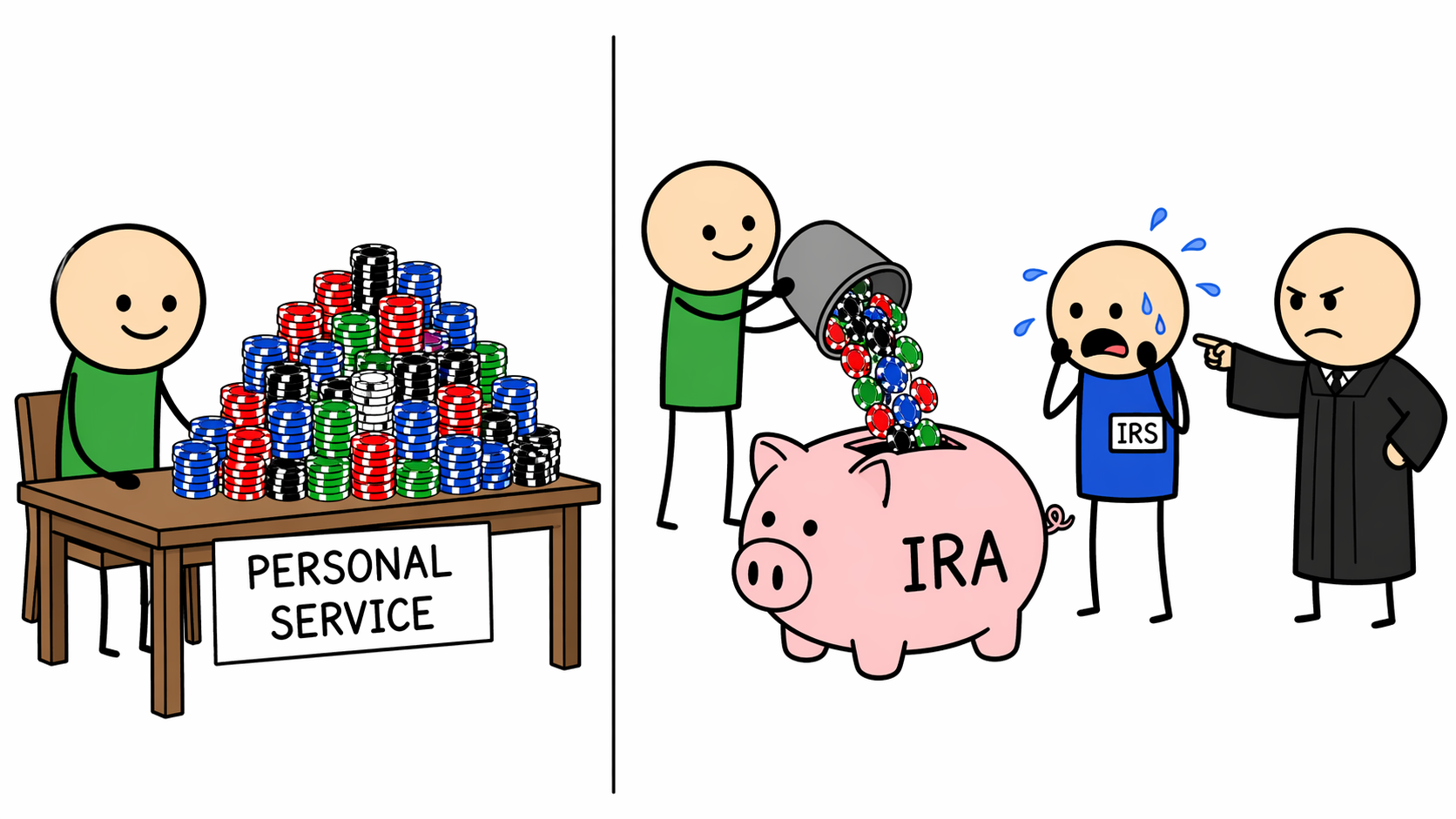
In the 1980s, professional poker player Billy Baxter got into a dispute with the IRS that redefined what "work" means. At the time, earned income was taxed at 50% while unearned income (gambling winnings) was taxed at 70%. Baxter argued his poker winnings were not luck. They were the result of his skill, his personal service. The IRS disagreed. The judge did not. After listening to Baxter explain his strategy, the judge ruled in his favor and told the IRS lawyers he wished they had some money so they could sit down with Baxter and play some poker. Because his winnings were now officially earned income, Baxter could contribute to retirement plans just like any other business owner. The case established that if your income comes from your personal skill and effort, it can qualify as earned income for retirement plan purposes, even if the IRS thinks it looks like gambling.
{{YEAR}} Contribution Limits
The IRS sets these annually. For 2026:
| Age | Annual Limit |
|---|---|
| Under 50 | $7,500 |
| 50 or older | $8,600 (includes $1,100 catch-up) |
A few things people get wrong here.
The $7,500 limit is the combined total across all your Traditional and Roth IRAs. You can split it however you want, $4,000 to a Traditional and $3,500 to a Roth, or $7,500 all to one. But you can't exceed $7,500 total ($8,600 if you're 50+).
You also can't contribute more than your earned income. If you made $5,000, your max contribution is $5,000. Not $7,500.
If you over-contribute, the IRS charges a 6% penalty on the excess amount for every year it stays in the account. That penalty doesn't go away until you fix it.
Tax Deductibility
This is where most of the confusion lives.
Everyone can contribute to a Traditional IRA. Not everyone can deduct the contribution on their taxes. The deductibility depends on two things: whether you (or your spouse) have a retirement plan at work, and how much you earn.
Scenario 1: No Workplace Retirement Plan
If neither you nor your spouse is covered by a retirement plan at work (no 401(k), no 403(b), no pension, nothing), your Traditional IRA contribution is fully deductible. No income limit. No phase-out. Simple.
Scenario 2: You Have a Workplace Plan
If you're covered by a retirement plan at work, the deduction starts to phase out based on your Modified Adjusted Gross Income (MAGI).
| Filing Status | Full Deduction | Partial Deduction | No Deduction |
|---|---|---|---|
| Single / Head of Household | MAGI ≤ $81,000 | $81,000 – $91,000 | Above $91,000 |
| Married Filing Jointly (contributor has workplace plan) | MAGI ≤ $129,000 | $129,000 – $149,000 | Above $149,000 |
Scenario 3: You Don't Have a Workplace Plan, But Your Spouse Does
This is the one that trips people up. You don't have a 401(k). Your spouse does. Can you deduct your IRA contribution? Maybe. There's a separate phase-out range for this situation.
| Situation | Full Deduction | Partial | No Deduction |
|---|---|---|---|
| MFJ: contributor has no workplace plan, but spouse does | MAGI ≤ $242,000 | $242,000 – $252,000 | Above $252,000 |
Scenario 4: Married Filing Separately
| Situation | Partial Deduction | No Deduction |
|---|---|---|
| MFS with a workplace plan | MAGI $0 – $10,000 | Above $10,000 |
That's not a typo. The phase-out starts at $0 and ends at $10,000. It's the most punishing phase-out range in the tax code for IRA contributions.
What If You Can't Deduct?
You can still contribute. It just won't reduce your tax bill. This is called a non-deductible Traditional IRA contribution.
Here's why that matters: when you eventually withdraw, you've already paid tax on the contribution. So you only owe tax on the earnings, not the original contribution amount. But you have to track this yourself using IRS Form 8606. If you don't file Form 8606, the IRS assumes your entire balance is pre-tax. You'll pay tax twice on the same money.
How Withdrawals Work
Before Age 59½
Withdrawals before age 59½ are taxed as ordinary income and hit with a 10% early withdrawal penalty on the taxable amount. Both. Income tax plus the penalty.
The penalty is the IRS's way of saying this money was supposed to be for retirement. Touch it early and there's a surcharge.
There are exceptions to the 10% penalty (see the next section). But even when the penalty is waived, the income tax still applies. The exceptions don't make the withdrawal tax-free. They just remove the 10% surcharge.
Age 59½ to 73
This is the sweet spot. You can take out whatever you want, whenever you want, with no penalty. You still owe ordinary income tax on the withdrawal, but no extra 10% on top.
You're not required to take anything during this window. The money can stay in the account and keep growing tax-deferred.
Age 73 and Beyond (Required Minimum Distributions)
This is where the IRS stops being patient.
Once you reach age 73, you must start taking Required Minimum Distributions (RMDs) every year. The government gave you a tax break going in. Now they want their money.
Your RMD is calculated by dividing your IRA balance as of December 31 of the prior year by a life expectancy factor from the IRS Uniform Lifetime Table. The older you get, the larger the percentage you must withdraw.
- Your first RMD is due by April 1 of the year after you turn 73. Every RMD after that is due by December 31 of each year.
- If you delay your first RMD to April 1, you'll have two RMDs in the same calendar yearthe delayed first one and the regular one for the current year. That can push you into a higher tax bracket.
- Miss an RMD or don't take enough? The penalty is 25% of the shortfall. File Form 5329 and correct it within two years, and that drops to 10%.
If you have multiple Traditional IRAs, you calculate the RMD for each one separately, but you can take the total amount from any one (or combination) of your Traditional IRAs. This is called the aggregation rule. It only applies across Traditional IRAs, you can't satisfy a Traditional IRA RMD from a 401(k), or vice versa.
Exceptions to the 10% Early Withdrawal Penalty
These let you avoid the 10% penalty before age 59½. The income tax still applies in most cases. Only the penalty is waived.
- Substantially Equal Periodic Payments (SEPP/72(t)): You commit to a series of substantially equal payments based on your life expectancy. You must continue for five years or until you turn 59½, whichever comes later. Modify the payments early and the IRS retroactively applies the 10% penalty to every distribution you took. This is not something to do casually.
- Disability: Permanent and total disability as defined by the IRS. The standard is strict, it must be a condition that prevents you from doing any substantial gainful activity, expected to be long-term or result in death.
- Death: Your beneficiaries receive distributions from an inherited IRA without the 10% penalty. They still owe income tax.
- Unreimbursed medical expenses: Medical expenses exceeding 7.5% of your adjusted gross income.
- Health insurance while unemployed: If you've received unemployment compensation for at least 12 consecutive weeks, you can withdraw to pay health insurance premiums for yourself, your spouse, or your dependents.
- First-time home purchase: Up to $10,000 lifetime limit. "First-time" means you haven't owned a home in the previous two years. Funds must be used within 120 days.
- Higher education expenses: Tuition, fees, books, supplies, and room and board (if enrolled at least half-time) at an eligible institution, for you, your spouse, children, or grandchildren.
- Birth or adoption: Up to $5,000 per parent per event. Added by the SECURE Act.
- IRS levy: If the IRS levies your IRA to pay back taxes, the 10% penalty doesn't apply.
- Qualified reservist distributions: Members of the National Guard or reserves called to active duty for 180+ days.
- Qualified disaster distributions: Up to $22,000 per federally declared disaster. Added by SECURE 2.0.
- Domestic abuse: Up to $10,000 (adjusted for inflation) or 50% of the account balance, whichever is less, within one year of the abuse.
- Emergency personal expense: One withdrawal up to $1,000 per calendar year for unforeseeable immediate financial need.
Rollovers and Transfers
Moving money between retirement accounts is common. But the rules are specific, and mixing them up creates tax problems.
Direct Transfer (Trustee-to-Trustee)
The money moves directly from one IRA custodian to another. You never touch it. No tax. No penalty. No limit on how many you can do per year.
This is the cleanest way to move IRA money. Always choose this when it's available.
60-Day Rollover
You receive the money personally, then deposit it into another IRA within 60 days. If you miss the 60-day window, the entire amount is treated as a taxable distribution, and if you're under 59½, the 10% penalty applies too.
You're limited to one 60-day rollover per 12-month period across all your IRAs. Not per account. Total. Do two in the same 12-month window and the second one is a taxable distribution. Why the 60-day rollover is almost never worth the risk →
The one-per-year rule doesn't apply to direct transfers. Another reason to always use direct transfers when possible.
401(k) to Traditional IRA Rollover
When you leave an employer, you can roll your 401(k) balance into a Traditional IRA. A direct rollover (check made payable to the new custodian) avoids withholding and tax complications.
If your employer sends you a check instead, they're required to withhold 20% for federal taxes. You then have 60 days to deposit the full amount (including the 20% withheld) into an IRA. You'd have to come up with that 20% out of pocket and claim the withholding back on your tax return.
Rollover vs. Contribution: Know the Difference
Rolling money from a 401(k) into an IRA is not a contribution. It doesn't count against your $7,500 annual limit. They're separate transactions with separate rules.
This seems obvious but it comes up constantly. People worry they can't do a rollover because they already maxed out their IRA contributions for the year. They can. Different rules. Rollover vs. transfer: they're not the same thing →
Roth Conversions
You can convert money from a Traditional IRA to a Roth IRA. The converted amount is added to your taxable income for the year. There's no limit on how much you can convert.
Why would you do this? Because once the money is in a Roth, it grows tax-free and comes out tax-free in retirement. No RMDs on Roth IRAs during your lifetime either.
The trade-off: you pay the tax bill now.
Conversions make the most sense in years when your income (and tax rate) is lower than what you expect it to be in retirement. They also make sense if you have a long time horizon for the converted money to grow.
We have a free comparison tool that runs the math for your specific situation: Roth vs. Traditional Comparison Tool →
Common Mistakes
These aren't hypothetical. These are the ones that show up repeatedly when working retirement accounts.
Not Tracking Non-Deductible Contributions
If you make non-deductible contributions and don't file Form 8606 every year, you will eventually pay tax on money that was already taxed. The IRS assumes everything in your Traditional IRA is pre-tax unless you can prove otherwise. The burden is on you.
Confusing the Contribution Deadline
People miss contributions because they think the deadline is December 31. It's not. You have until the tax filing deadline, usually April 15 of the following year. That's over three extra months to fund your IRA.
Exceeding the Contribution Limit
The $7,500 limit is across all your IRAs combined. If you contribute $5,000 to a Traditional and $4,000 to a Roth, you're $1,500 over. That triggers a 6% penalty for every year the excess stays in the account.
The One-Per-Year Rollover Mistake
You did a 60-day rollover in January. In October, you try another one. The second distribution is fully taxable. The one-per-year rule is absolute, and it covers all your IRAs, not just the one you rolled from.
Missing the First RMD Trap
You turn 73. You know your first RMD can be delayed until April 1 of the following year. So you wait. Now you owe two RMDs in the same year. That doubled income pushes you into a higher tax bracket and might trigger IRMAA surcharges on your Medicare premiums. The January RMD trap explained →
Not Naming (or Updating) Beneficiaries
Your IRA beneficiary designation overrides your will. If your ex-spouse is still listed as the beneficiary on your IRA, they get the money. Doesn't matter what your will says. Update your beneficiaries after every major life event. Why people keep avoiding this task →
Assuming the Custodian Tracks Everything for You
Your custodian reports distributions to the IRS. They don't track your cost basis on non-deductible contributions. They don't calculate your pro-rata ratio for Roth conversions. They don't know about your other IRAs at other custodians. That's all on you.
Run the numbers on your situation
Free tools built for the exact questions Traditional IRA owners run into.
A Traditional IRA looks simple until the questions stack up. Whether to convert before RMDs begin, how a conversion may affect tax brackets and Medicare premiums, and whether basis needs to be tracked. If more than one rule is in play, a 30-minute Retirement Rules Review can help map the rules, timelines, and questions to review next.
Book a Rules ReviewFrequently Asked Questions
Can I have a Traditional IRA and a 401(k) at the same time?
Yes. Anyone with earned income can contribute to a Traditional IRA regardless of whether they have a workplace plan. The only question is whether the IRA contribution is tax-deductible. Having a 401(k) doesn't prevent you from contributing. It may limit your deduction.
Can I have both a Traditional IRA and a Roth IRA?
Yes. You can contribute to both in the same year. The combined total across both accounts can't exceed $7,500 ($8,600 if you're 50+) for 2026.
What happens if I contribute to a Traditional IRA and later realize I wasn't eligible to deduct it?
Nothing bad, as long as you file Form 8606 to report it as a non-deductible contribution. You can also recharacterize the contribution as a Roth IRA contribution if you're within the deadline (typically October 15 of the following year with an extension). Or you can just leave it as a non-deductible Traditional IRA contribution and track the basis.
Can I withdraw my contributions at any time without penalty?
No. That's a Roth IRA rule, not a Traditional IRA rule. With a Traditional IRA, all withdrawals before 59½ are subject to income tax and the 10% penalty unless an exception applies. It doesn't matter whether the money came from contributions or earnings.
Is there a minimum amount to open a Traditional IRA?
The IRS doesn't set a minimum. Individual custodians might. Many brokerages let you open one with $0 and start contributing any amount.
What investments can I hold in a Traditional IRA?
Most common investments: stocks, bonds, mutual funds, ETFs, CDs, money market funds. You cannot hold life insurance or collectibles (art, antiques, gems, most coins). You also can't hold S corporation stock directly in an IRA.
What's the difference between a Traditional IRA and a Rollover IRA?
Functionally, nothing. A Rollover IRA is just a Traditional IRA that was funded with money from a former employer's retirement plan. Some people keep it separate for tracking purposes, but the IRS treats it the same way.
Can I contribute to a Traditional IRA if I'm self-employed?
Yes. Self-employment income counts as earned income. You can also contribute to a SEP IRA or Solo 401(k) on top of your Traditional IRA contribution. Different accounts, different limits.
Do I have to take RMDs if I'm still working at 73?
Yes, from your Traditional IRA. The still-working exception that lets you delay RMDs from a current employer's 401(k) does not apply to IRAs. IRA RMDs start at 73 (or 75 if you were born in 1960 or later) regardless of employment status. If you were born in 1959, SECURE 2.0 assigns you both 73 and 75 and the final regulations left the question open. The IRS has proposed 73 and has not finalized it, so plan on 73.
Can I undo a Traditional IRA contribution?
Yes. You can withdraw excess or unwanted contributions (plus any earnings on them) before the tax filing deadline without penalty. This is called removing an excess contribution. If you want to change a Traditional IRA contribution to a Roth contribution (or vice versa), that's called a recharacterization, and it must be done by the extended tax filing deadline.
What happens to my Traditional IRA when I die?
It passes to your designated beneficiaries. Spouse beneficiaries have the most flexibility, they can treat it as their own, roll it into their own IRA, or remain a beneficiary. Non-spouse beneficiaries are generally subject to the 10-year rule under the SECURE Act, meaning the entire account must be distributed within 10 years of the owner's death. Eligible designated beneficiaries (minor children, disabled or chronically ill individuals, beneficiaries not more than 10 years younger than the deceased) have additional options. See our Inherited IRA guide for the full breakdown.
Is a Traditional IRA better than a Roth IRA?
It depends on your current tax rate versus your expected tax rate in retirement. If you expect to be in a lower bracket in retirement, the Traditional IRA's upfront deduction is more valuable. If you expect to be in the same or higher bracket, the Roth IRA's tax-free withdrawals win. There's no universal answer. We built a free comparison tool that runs the math for your specific situation: Roth vs. Traditional Comparison Tool →
Related Knowledge Blasts
- The Pro-Rata Rule in Roth and Traditional IRAs: Why It Ruins Back-Door Strategies
- Why Your Roth Conversion Suddenly Looks More Taxable Than You Expected
- The January RMD Trap for People Who Turned 73 Last Year
- Recharacterizations Explained
- Excess Contribution Removal: What to Do Before the Deadline
- Who Actually Needs to File Form 8606 (And Who Really Doesn't)
- Required Minimum Distribution Penalty Relief
- Beneficiary Designations: The Year-End Task People Avoid Until It's Too Late
Primary IRS sources
Every rule, limit, deadline, and form number on this page traces back to the official IRS references below. Links open on irs.gov.
IRS Publication 590-A, Contributions to Individual Retirement Arrangements (IRAs)
IRS Publication 590-B, Distributions from Individual Retirement Arrangements (IRAs)
IRS: About Form 8606, Nondeductible IRAs
IRS: COLA increases for dollar limitations on benefits and contributions
Education-only disclaimer
This guide is for general education and information only. It does not provide individualized investment, tax, or legal advice, and does not establish a client relationship with any firm or individual. Always consult your own tax professional, financial advisor, or legal counsel before making decisions about your accounts, investments, or retirement strategy.
Get the retirement rule mistakes most people learn too late
Daily: one retirement rule trap, why it happens, and the fix. Everyday-language IRS rule breakdowns from an 8-year Schwab/TD Ameritrade veteran. Free.
Join the Rundown: Free