Rollover IRA: The Complete Guide (2026)
Everything you need to know about Rollover IRAs, the 60-day rule, the one-per-year rule, the 20% withholding trap, and the decisions that matter when you leave a job.
What Is a Rollover IRA?
A Rollover IRA is a Traditional IRA that holds money transferred from an employer-sponsored retirement plan like a 401(k), 403(b), 457(b), or pension plan.
That's it. There is no special account type. The IRS doesn't distinguish between a "Rollover IRA" and a "Traditional IRA." They follow the same rules, the same withdrawal rules, the same RMD rules, and the same tax treatment. The label "Rollover IRA" is an industry convention, not a tax code designation.
So why does the label exist? Two reasons.
Tracking. Some people keep rollover money in a separate IRA so they can distinguish between employer plan money and personal IRA contributions. This matters if you ever want to roll the money back into a future employer's 401(k). Some plans only accept rollover funds that have been kept separate, not commingled with personal contributions.
Clarity. When you leave a job and move your 401(k) to an IRA, calling it a "Rollover IRA" makes it clear where the money came from. Custodians use the label for organizational purposes.
When Do People Open a Rollover IRA?
The most common trigger is leaving a job. You have a 401(k) or other employer plan at your old company, and you need to decide what to do with it. Your four options:
1. Leave It in the Old Plan
Some plans allow former employees to keep their money in the plan. The money stays invested, follows the same plan rules, and you don't have to do anything.
When this makes sense: The plan has low fees and good investment options. You're happy with the plan and don't need to consolidate.
When it doesn't: The plan has high fees, limited investment choices, or the employer is small and the plan may be terminated. Some plans also charge higher administrative fees to former employees.
2. Roll It Into a New Employer's Plan
If your new employer has a 401(k) or other eligible plan that accepts incoming rollovers, you can move the money there. This keeps everything in one place and preserves the ability to borrow from the plan (if the new plan allows loans).
When this makes sense: You want simplicity, the new plan has good options and low fees, and you want access to 401(k) loan provisions.
When it doesn't: The new plan has limited or expensive investment options, or doesn't accept incoming rollovers.
3. Roll It Into a Rollover IRA
Move the money to an IRA at a custodian of your choice. You gain full control over investment options (individual stocks, bonds, ETFs, mutual funds, etc.) and can choose any custodian.
When this makes sense: You want more investment flexibility than the old or new employer plan offers. You want to consolidate old 401(k)s from multiple employers into one account.
When it doesn't: You're planning a Backdoor Roth IRA strategy. Having pre-tax IRA balances (including a Rollover IRA) triggers the pro-rata rule on Roth conversions. This is the single biggest reason to think carefully before rolling to an IRA.
4. Cash It Out
Take a distribution and pocket the money. The entire amount is taxable as ordinary income, and if you're under 59½, you owe a 10% early withdrawal penalty on top of the tax. For most people, this is the worst option.
Direct Rollover vs. 60-Day Rollover
This is the most important distinction in the rollover process. Getting it wrong costs real money.
Direct Rollover (Trustee-to-Trustee)
The money moves directly from the old plan to the new plan or IRA. You never touch it. A check may be issued, but it's made payable to the new custodian (e.g., "Fidelity FBO [Your Name]"), not to you personally.
60-Day Rollover (Indirect)
The old plan sends the money to you personally. You then have 60 days from the date you receive it to deposit it into an IRA or other eligible retirement plan. If you complete the deposit within 60 days, no tax. Miss the deadline by even one day, and the entire amount is treated as a taxable distribution.
This is where people get hurt.
The 20% Withholding Trap
When an employer plan sends you a distribution directly (a 60-day rollover), they're required by law to withhold 20% for federal income taxes. You don't get the full amount.
Example: Your 401(k) balance is $50,000. The plan sends you a check for $40,000 (after withholding $10,000 for taxes). You have 60 days to roll over the funds.
To make up the difference, you'd need to come up with $10,000 out of pocket, deposit all $50,000 into the IRA within 60 days, and then claim the $10,000 withholding as a tax credit on your return (you'll get it back when you file, but you have to front the money).
This is why direct rollovers are always better. No withholding. No math. No risk.
The One-Per-Year Rule
The IRS allows only one IRA-to-IRA 60-day rollover per 12-month period, across all your IRAs combined. Not per account. Total.
The 12-month period starts on the date you receive the distribution, not the date you deposit it.
Traditional IRAs and Roth IRAs are combined for this rule. A 60-day rollover from one Roth IRA to another counts as your one rollover. You can't then do a Traditional IRA 60-day rollover in the same 12-month window.
What this rule does NOT apply to:
- Direct trustee-to-trustee transfers (unlimited, do as many as you want)
- Rollovers from employer plans to IRAs (401(k) to IRA is not an IRA-to-IRA rollover)
- Rollovers from IRAs to employer plans
- Roth conversions (Traditional IRA to Roth IRA)
The one-per-year rule only applies to 60-day rollovers between IRAs. This is another reason to always use direct transfers.
Bobrow v. Commissioner
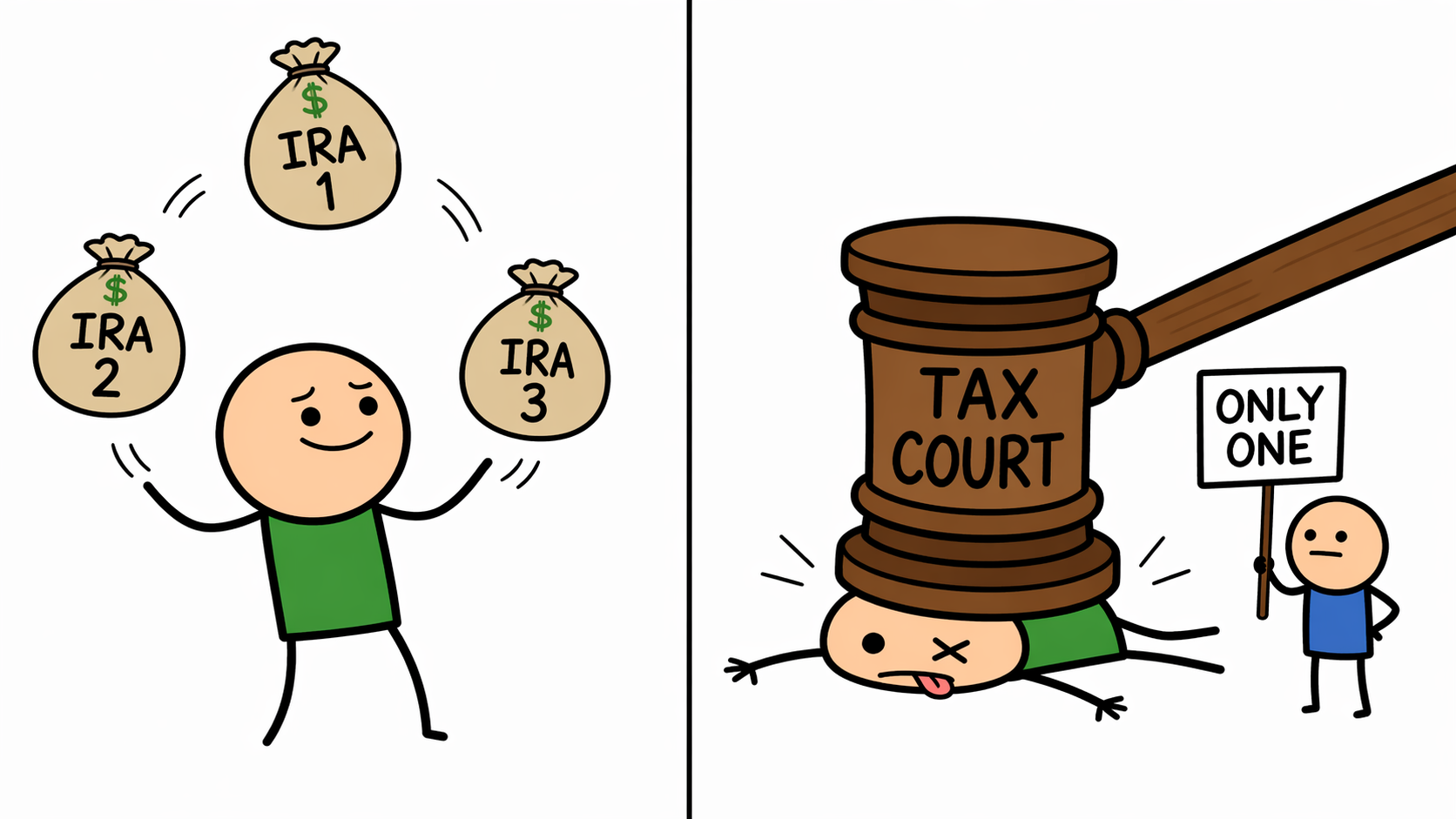
The once-per-year rule was not always applied this way. Before 2015, the IRS interpreted the limit as one rollover per account, not one rollover total. If you had three IRAs, you could do one indirect rollover from each. In 2014, a tax attorney named Alvan Bobrow tried exactly that, doing multiple indirect rollovers across different IRA accounts in the same year. The IRS challenged him. He lost in Tax Court. The court ruled that the once-per-year limit applies across all IRAs in aggregate, not per account. The IRS adopted that interpretation going forward, and beginning January 1, 2015, the rule became what it is today: one indirect IRA-to-IRA rollover per 12-month period across every IRA you own. Direct trustee-to-trustee transfers were not affected and remain unlimited. The irony of a tax attorney being the test case for a rule that every IRA owner needs to know is not lost on anyone who works in this space.
What Can Be Rolled Over?
Into a Rollover IRA
You can roll into a Traditional IRA (Rollover IRA) from:
- 401(k)
- 403(b)
- Governmental 457(b)
- Defined benefit plan (if a lump sum is offered)
- Other Traditional IRAs
- SEP IRAs (after the plan is no longer active, or anytime for the funds)
- SIMPLE IRAs (after the two-year participation period)
What Can't Be Rolled Over
- Required Minimum Distributions (the RMD for the year cannot be rolled over)
- Hardship distributions from a 401(k)
- Substantially equal periodic payments (72(t) distributions)
- Corrective distributions of excess contributions
- Loans treated as distributions (plan loan offsets have special rules)
Roth to Roth
Roth 401(k) money can be rolled to a Roth IRA. This is a direct rollover of Roth funds and is not taxable. The Roth IRA's 5-year clock (not the Roth 401(k) clock) determines when earnings are tax-free.
Pre-tax 401(k) money cannot be rolled directly into a Roth IRA without triggering a taxable conversion. If you want to convert, roll to a Traditional IRA first, then convert to Roth (or do an in-plan Roth conversion if the old plan supports it).
Should You Keep It Separate?
The question of whether to maintain a separate Rollover IRA or combine it with an existing Traditional IRA comes down to one factor: do you ever want to roll the money back into an employer plan?
Reasons to Keep It Separate
Future 401(k) rollover. Some employer plans only accept rollovers of funds that originated from another employer plan. If you commingle your rollover money with personal IRA contributions, the commingled account may not be eligible for a future roll-in. Keeping the Rollover IRA separate preserves that option.
Backdoor Roth strategy. If you plan to do Backdoor Roth IRA conversions, having pre-tax IRA money triggers the pro-rata rule. One solution is to roll the Rollover IRA into your current employer's 401(k) (if allowed), zeroing out your Traditional IRA balances. This only works if the money hasn't been commingled.
Creditor protection. In some states, funds in an IRA that originated from an ERISA-qualified plan retain stronger creditor protection than funds from personal IRA contributions. Keeping them separate may preserve that protection. This varies by state, consult an attorney if this matters to you.
Reasons to Combine
Simplicity. One fewer account to manage, track, and take RMDs from.
No plans to reverse the rollover. If you're confident you won't need to roll the money back into an employer plan, keeping it separate adds complexity for no benefit.
The Pro-Rata Rule and Backdoor Roth
This is the biggest planning consideration for anyone with a Rollover IRA.
If you have any pre-tax money in any Traditional, SEP IRA, or SIMPLE IRA and you attempt a Roth conversion (including a Backdoor Roth), the IRS applies the pro-rata rule. It looks at the total balance across all your Traditional IRAs and calculates what percentage is pre-tax vs. after-tax. The conversion is taxed proportionally.
The fix: Roll the Rollover IRA into your current employer's 401(k) before doing the Backdoor Roth. The 401(k) balance is not included in the pro-rata calculation, only IRA balances count. Once your Traditional IRA balances are zero, the Backdoor Roth works cleanly.
Not all employer plans accept incoming rollovers. Check with your plan administrator before counting on this strategy.
For the full explanation of the pro-rata rule, see our Traditional IRA Guide.
How Withdrawals Work
A Rollover IRA follows standard Traditional IRA withdrawal rules.
Before 59½: Withdrawals are taxed as ordinary income plus a 10% early withdrawal penalty, unless an exception applies. The same exceptions that apply to any Traditional IRA (disability, first-time home purchase, SEPP, education expenses, etc.) apply here.
After 59½: No penalty. Withdrawals are taxed as ordinary income.
RMDs start at 73 (or 75 if born in 1960 or later). For those born in 1959, the IRS has proposed an RMD age of 73, but that rule is not final yet.
Rollover from a Roth 401(k)
If you have a Roth 401(k) at your former employer, you can roll it into a Roth IRA. The rolled-over contributions and earnings maintain their Roth status.
Key detail: the 5-year clock for tax-free earnings in the Roth IRA is based on when you first contributed to any Roth IRA, not when the Roth 401(k) was opened. If you've had a Roth IRA open for more than 5 years, the rolled-over funds are immediately eligible for qualified (tax-free) distributions (assuming you're 59½ or older).
If you've never had a Roth IRA, the 5-year clock starts when the rollover hits the Roth IRA. This is why opening a Roth IRA early, even with a small contribution, is always good advice. Start the clock.
Common Mistakes
Missing the 60-Day Deadline
One day late and the entire amount is a taxable distribution. If you're under 59½, the 10% penalty applies too. The IRS can grant waivers for circumstances beyond your control (hospitalization, disability, postal error, financial institution error), but the process is not guaranteed. Use direct rollovers to avoid this risk entirely.
Not Replacing the 20% Withholding
You receive $40,000 of a $50,000 distribution. You roll over $40,000. The $10,000 withheld is taxable income, and you may owe a penalty on it. To avoid this, you must deposit $50,000 total into the IRA within 60 days, coming up with the $10,000 from other sources.
Violating the One-Per-Year Rule
You do an IRA-to-IRA 60-day rollover in March. In November, you try another. The second one fails, it's a taxable distribution, and if you deposit it into an IRA anyway, it's an excess contribution. The IRS cannot waive this rule. Direct transfers are exempt from the one-per-year limit.
Rolling Over When You Should Have Left It
If you're between 55 and 59½ and planning to retire, rolling your 401(k) to an IRA loses the Rule of 55. You'll pay a 10% penalty on IRA withdrawals that would have been penalty-free from the 401(k).
Rolling Over Without Checking the Pro-Rata Impact
You roll your 401(k) into a Traditional IRA, then try a Backdoor Roth conversion. The Rollover IRA balance makes most of the conversion taxable and gets tracked on Form 8606. Check your Roth conversion plans before rolling over.
Cashing Out Instead of Rolling Over
Taking a lump-sum distribution instead of rolling over triggers immediate taxation of the entire amount plus the 10% penalty if you're under 59½. A $100,000 401(k) becomes $60,000–$70,000 after taxes and penalties. That lost $30,000–$40,000 can never be recovered.
Forgetting About Old 401(k)s
Americans leave billions of dollars in old 401(k) plans at former employers. If you've changed jobs multiple times, check whether you have forgotten accounts. Roll them into a single Rollover IRA for consolidation and easier management.
Planning a Rollover? Check the Math First.
Rolling over to an IRA can trigger the pro-rata rule on future Roth conversions. Use the Pro-Rata Calculator to see the impact before you move the money.
All tools include step-by-step explanations. See pricing →
Most rollovers are routine until one is not. The once-per-year IRA rollover rule, a missed 60-day deadline, withholding, and unexpected tax reporting can all create problems. A 30-minute Retirement Rules Review can help map what happened and what questions to ask next.
Book a Rules ReviewFAQ
Is a Rollover IRA different from a Traditional IRA?
Functionally, no. A Rollover IRA is a Traditional IRA that was funded with money from an employer-sponsored plan. The IRS treats them identically. The "Rollover" label is an industry convention for tracking purposes.
Can I contribute to a Rollover IRA?
Yes. You can make personal Traditional IRA contributions (up to $7,500 for 2026, or $8,600 if 50+) to a Rollover IRA, subject to the same deductibility rules as any Traditional IRA. However, doing so commingles the rollover funds with personal contributions, which may prevent you from rolling the money back into an employer plan later.
Can I roll a Rollover IRA back into a 401(k)?
Yes, if the 401(k) plan accepts incoming rollovers. This is one of the key reasons to keep rollover money in a separate account. Not all plans accept rollovers, and some only accept funds that haven't been commingled with personal contributions.
Can I roll my Rollover IRA into a Roth IRA?
Yes. This is a Roth conversion. The converted amount is taxable income in the year of conversion. There's no limit on how much you can convert. This is a strategic move in lower-income years. See our Roth IRA guide for the full details on conversions and the 5-year rules.
Does a Rollover IRA affect my Backdoor Roth?
Yes. Any pre-tax balance in a Traditional, Rollover, SEP, or SIMPLE IRA triggers the pro-rata rule on Roth conversions. If you want to do a clean Backdoor Roth, you need to zero out those IRA balances first, typically by rolling them into a current employer's 401(k).
What if I have both pre-tax and after-tax money in my 401(k)?
When you roll over, the pre-tax money goes to a Traditional (Rollover) IRA and the after-tax money can go to a Roth IRA. Many plans allow you to split the rollover so each portion goes to the appropriate account. Ask your plan administrator.
Can I roll over a pension?
If your pension offers a lump-sum distribution option, you can roll it into a Rollover IRA. Not all pensions offer this. If the pension only pays as a monthly annuity, there's nothing to roll over.
What happens to my Rollover IRA when I die?
Same as any Traditional IRA, it passes to your designated beneficiaries. The distribution rules depend on who inherits (spouse, non-spouse, entity) and when the owner died. See our Inherited IRA (Individual Beneficiary) guide.
Do I have to take RMDs from a Rollover IRA?
Yes. Same RMD rules as any Traditional IRA. RMDs begin at 73 (or 75 if born in 1960 or later). If you have multiple Traditional IRAs (including Rollover IRAs), you calculate the RMD for each but can take the total from any one or combination.
Is there a limit on how much I can roll over?
No. The full balance of your employer plan can be rolled over. Rollover amounts are not subject to the annual IRA contribution limit ($7,500). Rollovers and contributions are separate transactions with separate rules.
Related Knowledge Blasts
Short, plain-English breakdowns of the rules behind this guide:
- The 60-Day Rollover Rule: Why It's Almost Never Worth the Risk →
- What Actually Happens in an Indirect Rollover? →
- Rollover vs. Transfer: They Are NOT the Same Thing →
- Why Rollovers Break When Timing Slips →
- The Pro-Rata Rule in Roth and Traditional IRAs: Why It Ruins "Clean" Moves →
- When a Backdoor Roth Works on Paper but Fails on the Tax Return →
- Excess Contribution Removal: What to Do Before the Deadline →
- The Biggest Retirement Mistake Nobody Notices Until Their First RMD →
Primary IRS sources
Every rule, limit, deadline, and form number on this page traces back to the official IRS references below. Links open on irs.gov.
IRS Publication 590-A, Contributions to Individual Retirement Arrangements (IRAs)
IRS Publication 590-B, Distributions from Individual Retirement Arrangements (IRAs)
Education-only disclaimer
This guide is for general education and information only. It does not provide individualized investment, tax, or legal advice, and does not establish a client relationship with any firm or individual. Always consult your own tax professional, financial advisor, or legal counsel before making decisions about your accounts, investments, or retirement strategy.
Get the retirement rule mistakes most people learn too late
Daily: one retirement rule trap, why it happens, and the fix. Everyday-language IRS rule breakdowns from an 8-year Schwab/TD Ameritrade veteran. Free.
Join the Rundown: Free