Qualified Charitable Distributions (QCDs): The Complete Guide
How to donate directly from your IRA, satisfy your RMD, and reduce your taxable income at the same time. The rules, the limits, the mistakes, and the tax benefits most people miss.
What Is a QCD?
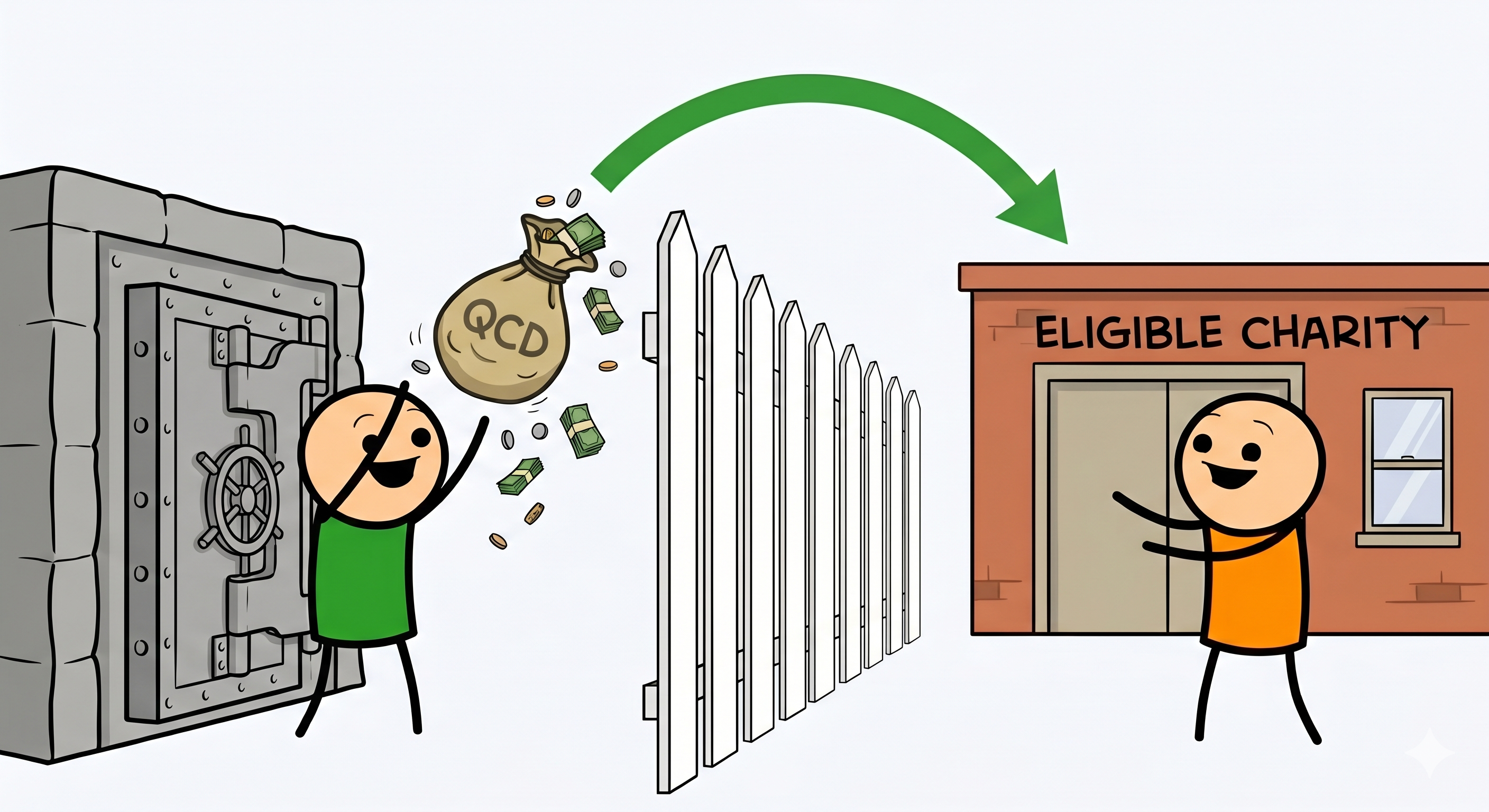
A Qualified Charitable Distribution is a direct transfer from your IRA to a qualified charity. The money goes from your IRA custodian straight to the charitable organization without passing through your hands. The distribution is excluded from your taxable income.
If you have a Required Minimum Distribution, the QCD counts toward satisfying it. The result is that you donate the same amount you would have donated anyway, your RMD obligation is met, and your taxable income is lower than it would have been if you had taken the RMD as cash and donated from your bank account.
The IRS does not care about your charitable intent. It cares about the mechanics. The money must go directly from the IRA to the charity. That single requirement is what makes the entire tax benefit work.
Who Is Eligible
You must be age 70½ or older on the date of the distribution. Not 70. Not 71 on your next birthday. 70½ on the day the QCD is processed.
The age threshold is 70½ regardless of when your RMDs begin. Under current rules, RMDs start at age 73, but QCD eligibility starts at 70½. That means you can make QCDs for two and a half years before your first RMD is even due.
The QCD must come from a traditional IRA, an inherited IRA, or an inactive SEP or SIMPLE IRA (one that is no longer receiving employer contributions). Roth IRAs are technically eligible but there is rarely a reason to use a Roth for QCDs since Roth distributions are already tax-free. QCDs from employer plans (401(k), 403(b)) are not allowed. The money must come from an IRA.
The Annual Limit
The QCD limit is a per-person annual limit that is indexed for inflation each year (check the current year's limit on the IRS website). If you are married and both spouses are 70½ or older, each spouse can make up to the per-person limit in QCDs from their own IRAs, which is double the individual limit for married couples where both spouses are 70½ or older.
The limit applies to the total of all QCDs made during the calendar year, regardless of how many charities receive distributions.
SECURE 2.0 introduced a one-time provision allowing a QCD to fund a charitable remainder trust or charitable gift annuity at half the annual QCD limit, but this is a one-time election and counts against the annual limit.
How a QCD Satisfies Your RMD
If you are required to take an RMD and you make a QCD, the QCD amount counts toward your RMD for the year. If your RMD is $25,000 and you make a $10,000 QCD, you have satisfied $10,000 of your RMD. You still need to distribute another $15,000 by December 31, either as a regular distribution or additional QCDs.
If your QCD equals or exceeds your RMD, your entire RMD obligation is met and none of the distributed amount is included in your taxable income.
You must take your QCD before or at the same time as your remaining RMD. The IRS applies QCDs to your RMD first. If you take your full RMD as a regular taxable distribution in January and then make a QCD in November, the QCD does not retroactively reclassify your January distribution.
The order matters for planning purposes, not for IRS compliance, but most tax professionals recommend making the QCD early in the year to ensure it is applied against the RMD.
The Tax Benefit Most People Miss
A QCD is not the same as a charitable deduction. It is better.
A charitable deduction reduces your taxable income only if you itemize. With the standard deduction, which for most retirees exceeds their total charitable giving, most retirees do not itemize. Their charitable donations generate zero tax benefit.
A QCD bypasses the deduction entirely. The money is excluded from income before it ever reaches your adjusted gross income. You get the tax benefit whether you itemize or not.
A retiree who takes the standard deduction and donates $10,000 to charity from their bank account gets no tax benefit from the donation. The same retiree making a $10,000 QCD reduces their taxable income by $10,000 regardless of whether they itemize. The donation is the same. The charity receives the same amount. The tax outcome is completely different based on which account the money comes from.
IRMAA, Social Security, and the AGI Ripple Effect
Because a QCD reduces your adjusted gross income, the benefits extend beyond the income tax savings.
Medicare Part B and Part D premiums are based on your Modified Adjusted Gross Income from two years prior through IRMAA. A lower AGI in the current year means potentially lower Medicare premiums two years from now.
Social Security benefits are taxed based on provisional income, which includes half your Social Security plus all other income. A QCD reduces the "all other income" portion of that calculation, which can reduce how much of your Social Security is subject to tax.
The threshold where 50% of Social Security becomes taxable is $25,000 (single) or $32,000 (married). The threshold where 85% becomes taxable is $34,000 (single) or $44,000 (married). A $10,000 QCD that keeps your provisional income below one of those thresholds saves you tax on both the IRA distribution and on your Social Security benefits. The combined savings can be significantly larger than the income tax on the QCD amount alone.
How to Execute a QCD Correctly
Contact your IRA custodian and request a Qualified Charitable Distribution. Provide the charity name, address, and the amount. The custodian issues a check payable directly to the charity.
Some custodians mail the check to the charity. Others mail it to you with the charity's name as the payee so you can forward it. Either way, the check must be made out to the charity, not to you. If the custodian offers direct electronic transfer to the charity, that also qualifies.
Keep a record of the distribution including the date, amount, charity name, and confirmation from the custodian that the distribution was coded as a QCD.
Your custodian reports the distribution on Form 1099-R. Historically, there was no special code for QCDs on Form 1099-R, and distributions typically showed as a normal distribution (Code 7) in Box 7. Beginning with 2025 reporting, custodians may optionally use Code Y to flag QCDs (see Form 1099-R reporting and Code Y below for details). It is your responsibility to report the QCD correctly on your tax return and to have documentation if the IRS questions it.
Your 1099-R will show the full distribution amount in Box 1. You report the taxable portion on your return by excluding the QCD amount from the taxable line. The IRS instructions for Form 1040 explain the procedure for Line 4a (total distribution) and Line 4b (taxable amount).
Form 1099-R reporting and Code Y
Your IRA custodian issues Form 1099-R for the total amount distributed from your IRA, including the QCD portion. The 1099-R shows the gross distribution. It does not separately identify the QCD amount.
Starting with 2025 reporting (filed in 2026), the IRS introduced an optional Box 7 code: Code Y. When used, it signals that a distribution was a Qualified Charitable Distribution. Code Y is combined with other distribution codes (Y7 for a normal distribution, Y4 for a beneficiary distribution, and so on).
Two important points about Code Y
Adoption is phased across custodians. Some are implementing immediately. Some are deferring. Your 1099-R may or may not show Code Y even if your distribution qualified as a QCD. The absence of Code Y does not mean your QCD was wrong.
Code Y does not replace your manual reporting on Form 1040. Even with Code Y on the 1099-R, you still need to report the QCD correctly on your tax return. The custodian may report that a distribution was intended to be a QCD, but you are still responsible for claiming the correct tax treatment on your return.
Reporting on Form 1040
- Line 4a: Enter the total IRA distribution shown on Form 1099-R.
- Line 4b: Enter the taxable portion. If the entire distribution was a QCD, this is $0. If only part of the distribution was a QCD, enter the difference between the total IRA distribution and the QCD amount.
- Line 4c: Check box 2 for QCD.
That is the critical step. Without the QCD box checked, the IRS sees the IRA distribution but may not see the QCD treatment. Your return may be flagged and you may receive a notice claiming you owe tax on money you gave to charity.
The Mistakes That Disqualify a QCD
The most common error is receiving the check yourself. If the check is made out to you personally, even if you immediately endorse it to the charity or write your own check for the same amount the same day, the distribution is taxable. The IRS treats it as a regular distribution followed by a charitable donation. You may be able to deduct the donation if you itemize, but you lose the QCD exclusion from income and the AGI reduction benefits that come with it.
The second common mistake is making a QCD before age 70½. Even if you are 70 and turn 70½ later in the year, the QCD must occur on or after the date you actually reach 70½.
The third mistake is directing the QCD to an ineligible organization. Donor-advised funds, private foundations, and supporting organizations do not qualify for QCDs. The charity must be a 501(c)(3) public charity.
The fourth mistake is not telling your tax preparer. Because the 1099-R does not flag QCDs with a special code, your tax preparer may treat the entire distribution as taxable income unless you provide documentation showing the QCD was made.
QCDs and Donor-Advised Funds
Donor-advised funds do not qualify as recipients of QCDs. This is a statutory exclusion. Even though a donor-advised fund is housed within a 501(c)(3) public charity (like Fidelity Charitable or Schwab Charitable), the QCD cannot be directed to the donor-advised fund account.
If you make a distribution from your IRA to a donor-advised fund, the IRS treats it as a regular taxable distribution followed by a charitable contribution, not a QCD.
This distinction matters for retirees who use donor-advised funds as their primary charitable giving vehicle. The QCD must go directly to the end charity, not to an intermediary giving account. If your charitable strategy relies heavily on a donor-advised fund, QCDs require a parallel approach where some donations go through the DAF and some go directly from the IRA to the charity.
QCDs and Non-Deductible Basis
If you have non-deductible contributions (basis) in your traditional IRA, a QCD interacts with the pro-rata rule in a specific way. Under IRS guidance, QCDs are treated as coming first from the taxable portion of your IRA, not from your basis.
This means a QCD does not reduce your basis. If you have $20,000 in non-deductible basis and make a $10,000 QCD, your basis remains $20,000. The QCD absorbed $10,000 of what would have been taxable income, and your basis is preserved for future distributions or conversions.
This is actually an advantage. The QCD removes taxable dollars from the IRA while leaving your after-tax basis intact. If you are planning a Roth conversion and also making charitable donations, doing the QCD first (to remove taxable dollars) and then converting (where basis offsets some of the tax) is a more tax-efficient sequence than converting first and donating from the proceeds.
Common Scenarios
Scenario 1: Standard Deduction + Regular Charitable Giving
A 75-year-old retiree has a $400,000 traditional IRA, an RMD of $16,000, and donates $12,000 per year to her church from her checking account. She takes the standard deduction, so the charitable donation provides no tax benefit. If she makes a $12,000 QCD instead, she satisfies $12,000 of her RMD, reduces her taxable income by $12,000, and still needs to take $4,000 as a regular distribution to complete her RMD. At the 22% bracket, the QCD saves her $2,640 per year in federal income tax. The church receives the same $12,000 either way.
Scenario 2: Married Couple Crossing an IRMAA Threshold
A married couple, both over 73, have combined RMDs of $40,000 and donate $20,000 per year to various charities. They make $20,000 in combined QCDs ($10,000 from each spouse's IRA). The QCDs satisfy half their combined RMD obligation and reduce their AGI by $20,000. The lower AGI keeps them below an IRMAA threshold, saving them $2,400 per year in Medicare surcharges on top of the income tax savings.
Scenario 3: QCD Before RMDs Begin
A 72-year-old retiree wants to make a QCD but is not yet required to take RMDs (which start at 73). She is eligible because she is over 70½. She makes a $5,000 QCD from her traditional IRA. The distribution is excluded from income. It does not count as an RMD because she does not have one yet. But it still reduces her AGI, which reduces her provisional income for Social Security taxation purposes. QCDs before RMDs begin are purely elective but can be strategically valuable for managing AGI.
Run the numbers on your situation
Free tools that model the AGI, IRMAA, and tax impact of QCD strategies.
Related Guides
Frequently Asked Questions
What is a Qualified Charitable Distribution?
A QCD is a direct transfer from your IRA to a qualified 501(c)(3) public charity. The money goes from the custodian straight to the charity without passing through your hands. The distribution is excluded from your taxable income, and if you have an RMD, the QCD counts toward satisfying it.
At what age can I make a QCD?
You must be 70½ or older on the date of the distribution. The age threshold is 70½ regardless of when your RMDs begin. RMDs start at 73 under current law, so you can make QCDs for two and a half years before your first RMD is even due.
Does a QCD count toward my RMD?
Yes. A QCD counts toward your Required Minimum Distribution dollar-for-dollar. If your RMD is $25,000 and you make a $10,000 QCD, you have satisfied $10,000 of the RMD and need to distribute another $15,000 by December 31. If your QCD equals or exceeds the RMD, the entire obligation is met and none of the distributed amount is taxable.
Can I make a QCD from my 401(k)?
No. QCDs must come from an IRA, traditional, inherited, or an inactive SEP or SIMPLE IRA that is no longer receiving employer contributions. QCDs from 401(k), 403(b), or other employer plans are not allowed. If your money is in a workplace plan, you would need to roll it to an IRA first.
What happens if the check is made out to me?
It is no longer a QCD. Even if you immediately endorse the check to the charity or write your own check for the same amount the same day, the IRS treats the distribution as taxable income followed by a charitable donation. You may be able to deduct the donation if you itemize, but you lose the QCD exclusion from income and the AGI reduction benefits.
Can I make a QCD to a donor-advised fund?
No. Donor-advised funds, private foundations, and supporting organizations are statutorily excluded from receiving QCDs. The QCD must go directly to a 501(c)(3) public charity. If your charitable strategy uses a donor-advised fund, QCDs require a parallel approach: some donations through the DAF, some directly from the IRA to the end charity.
How do I report a QCD on my tax return?
Your custodian reports the distribution on Form 1099-R, but there is no special box-7 code for QCDs (it usually shows as Code 7, normal distribution). It is your responsibility to report the QCD correctly on your return: enter the full distribution on Form 1040 Line 4a (total distribution) and exclude the QCD amount from Line 4b (taxable amount). Keep the custodian's QCD confirmation and the charity's acknowledgment with your records.
What is the annual QCD limit?
The QCD limit is a per-person annual amount indexed for inflation each year. Check the current year's limit on the IRS website. Married couples where both spouses are 70½ or older can each make their own QCDs from their own IRAs, doubling the household total. The limit applies to all QCDs in a calendar year combined, regardless of how many charities receive distributions.
Does a QCD reduce my Medicare premiums?
It can, indirectly. Medicare Part B and Part D premiums are based on your Modified Adjusted Gross Income from two years prior (IRMAA). Because a QCD is excluded from AGI, it can lower your AGI compared to taking the same dollars as a regular distribution and donating from your bank account. A lower AGI in the current year means potentially lower Medicare premiums two years from now. The RMD & Roth Conversion Planner models both tax and IRMAA impact.
Can I make a QCD before my RMDs start?
Yes. QCD eligibility starts at 70½, but RMDs start at 73 under current law. Between 70½ and 73 you can make QCDs even though you are not required to take any distributions. The QCD reduces your AGI, which can affect Social Security taxation and IRMAA exposure. It is purely elective during this window but can be strategically valuable for managing AGI.
Education-only disclaimer
This guide is for general education and information only. It does not provide individualized investment, tax, or legal advice, and does not establish a client relationship with any firm or individual. Always consult your own tax professional, financial advisor, or legal counsel before making decisions about your accounts, investments, or retirement strategy.
Get the retirement rule mistakes most people learn too late
Daily: one retirement rule trap, why it happens, and the fix. Everyday-language IRS rule breakdowns from an 8-year Schwab/TD Ameritrade veteran. Free.
Join the Rundown: Free