Small-Business Retirement Plans, Simplified
SEP IRAs, SIMPLE IRAs, and Solo 401(k)s compared side by side. Which plan fits which business, what the real contribution math looks like, and the questions every business owner should ask before choosing.
Why This Decision Matters
Choosing the wrong small-business retirement plan is not a catastrophic mistake. It is a slow leak.
The wrong plan means lower contribution limits, missed Roth access, unnecessary employer obligations, or setup deadlines that force you into a plan you didn't actually want.
Most business owners pick a plan because their accountant suggested it in passing or because it was the first result on Google. Then they stick with it for years without realizing a different structure could have sheltered $20,000 or $30,000 more per year.
The three plans that matter for most small businesses and self-employed individuals are the SEP IRA, the SIMPLE IRA, and the Solo 401(k). Each one has a specific situation where it wins. None of them is universally best.
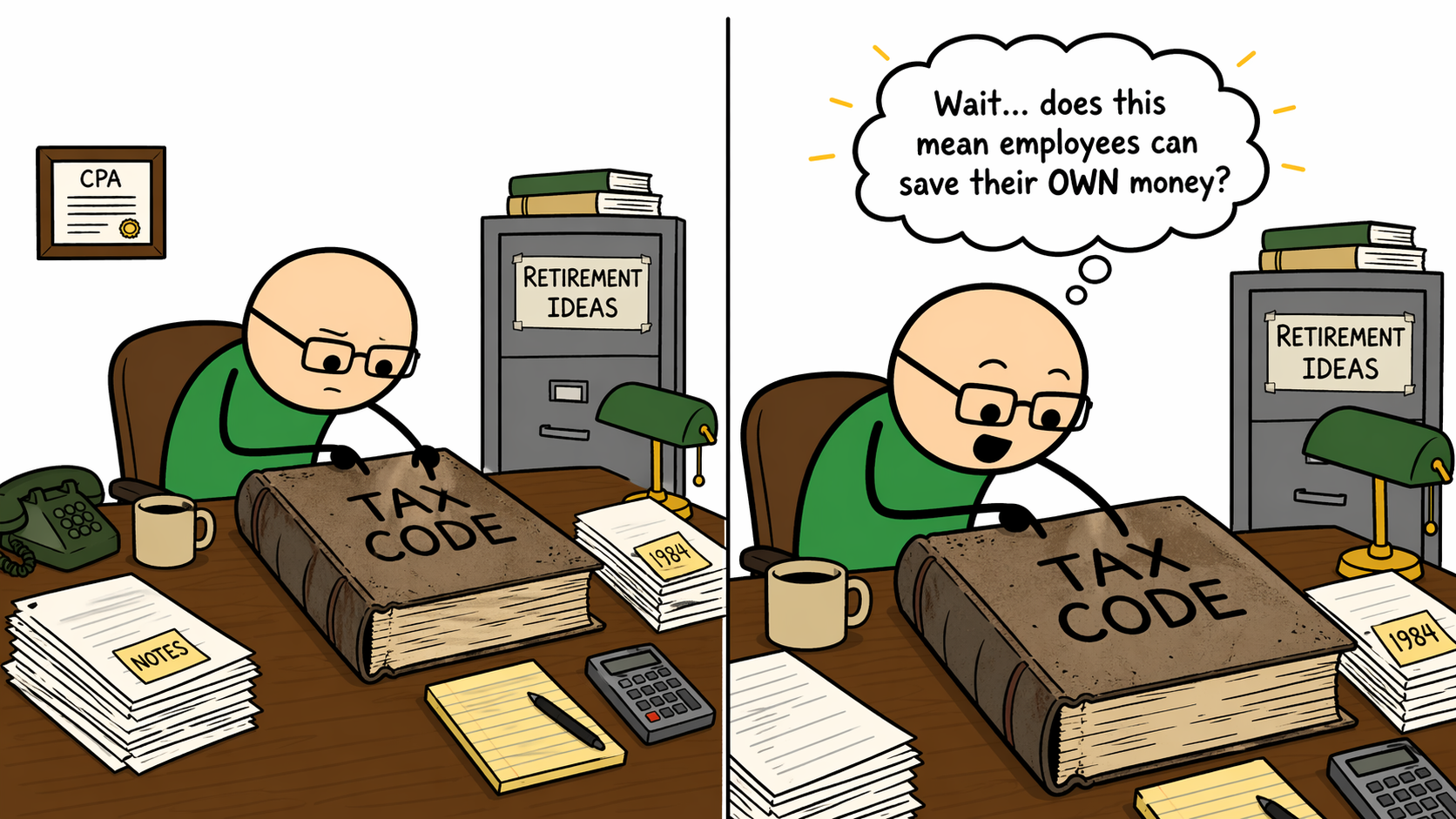
The 401(k) was never supposed to be the primary retirement system for America. In 1978, Congress added Section 401(k) to the tax code to solve a technical dispute about how bank employees could receive year-end bonuses. Two years later, a benefits consultant named Ted Benna realized the wording was broad enough to create a savings plan where employees could defer their own salary and get a company match. He pitched it to his own company first because his clients thought it sounded too aggressive to be legal. Today, Benna is known as the "Father of the 401(k)," though he has said he "created a monster" because the system became so complex and fee-heavy. The plan you are choosing between on this page exists because one consultant read a tax code section more creatively than Congress intended.
The plain-English version of IRS Publication 560
If you have searched for retirement plan rules as a business owner, you have probably run into IRS Publication 560, Retirement Plans for Small Business. It is the IRS's official reference for the plans a business can set up: SEP plans, SIMPLE plans, and qualified plans like the solo 401(k), safe harbor 401(k), and defined benefit and cash balance plans. For each plan it explains what type to set up, how to set it up, how much you can contribute, how much is deductible, how distributions are treated, and what you have to report.
Publication 560 is thorough, but it is written in IRS language, and it does not cover the IRA rules that individuals need. It sends you to Publications 590-A and 590-B for those. This site is built to be the plain-English version. Each plan Publication 560 describes has its own full walkthrough here.
The SEP IRA is the simplest employer plan, where only the employer contributes, up to 25 percent of compensation. See the SEP IRA guide.
The SIMPLE IRA is for businesses with 100 or fewer employees, with employee salary-reduction contributions and a required employer match or nonelective contribution. See the SIMPLE IRA guide.
The Solo 401(k) is for owner-only businesses, combining employee deferrals and employer contributions in one plan. See the Solo 401(k) guide.
The Safe Harbor 401(k) sidesteps annual nondiscrimination testing in exchange for required employer contributions. See the Safe Harbor 401(k) guide.
Cash balance and defined benefit plans are the qualified plans that allow the largest contributions for high earners. See the Cash Balance Plans guide.
If you are not sure which plan fits, this guide compares all of them and points you to the right one. Publication 560 is the rulebook. These guides are the translation.
SEP IRA at a Glance
The SEP IRA (Simplified Employee Pension) is the easiest plan to set up and maintain. Contributions are employer-only. There are no employee salary deferrals.
The employer contributes up to 25% of each employee's compensation (or 25% of net self-employment income for sole proprietors, after the self-employment tax deduction). The maximum contribution is $72,000 for 2026. There is no catch-up contribution for people over 50. There is no Roth option.
The plan can be established and funded as late as the tax filing deadline, including extensions. That means you can set up a SEP IRA in October of the following year (if you filed an extension) and make a contribution for the prior tax year. No other plan offers that flexibility.
For a sole proprietor with high income and no employees, the SEP IRA delivers large contributions with minimal paperwork.
For a business with employees, the SEP requires equal percentage contributions for all eligible employees. If you contribute 25% for yourself, you contribute 25% for every qualifying employee. That cost scales quickly.
SIMPLE IRA at a Glance
The SIMPLE IRA (Savings Incentive Match Plan for Employees) is designed for businesses with 100 or fewer employees. It allows both employee salary deferrals and employer contributions.
Employees can defer up to $17,000 per year (with a $4,000 catch-up for those 50 and older). SECURE 2.0 added an enhanced catch-up for participants age 60 through 63, allowing up to $5,250 in additional catch-up contributions.
The employer must either match employee contributions dollar-for-dollar up to 3% of compensation, or make a flat 2% non-elective contribution for all eligible employees regardless of whether they defer.
The total contribution capacity is lower than a SEP or Solo 401(k). The maximum employee deferral plus employer match typically caps well below the $72,000 limit available in the other plans.
The SIMPLE IRA has a critical restriction: the two-year rule. During the first two years of participation (measured from the date of the first contribution), any rollover out of the SIMPLE IRA to a non-SIMPLE account triggers a 25% early distribution penalty instead of the standard 10%. This penalty applies even if the rollover is to a traditional IRA. The two-year clock is per participant, not per plan.
The SIMPLE IRA must be established by October 1 of the year it will take effect. You cannot set up a SIMPLE IRA retroactively the way you can a SEP.
Solo 401(k) at a Glance
The Solo 401(k) (also called an Individual 401(k) or one-participant 401(k)) is available to self-employed individuals and business owners with no employees other than a spouse. It offers the highest contribution flexibility of any small-business plan.
Contributions have two components: employee salary deferrals up to $24,500 (plus $8,000 catch-up if 50 or older, or $11,250 super catch-up if age 60 through 63), and employer profit-sharing contributions up to 25% of compensation. The combined limit is $72,000 (or $80,000 with standard catch-up, or $83,250 with the super catch-up).
The Solo 401(k) also offers a Roth option for employee deferrals. You can split your deferrals between traditional (pre-tax) and Roth (after-tax) within the same plan. Some Solo 401(k) plans also allow after-tax contributions and in-plan Roth conversions (the "mega backdoor Roth"), though this depends on the plan provider.
The Solo 401(k) allows participant loans (borrowing from your own plan balance), which neither the SEP nor the SIMPLE offers.
The administrative requirements are higher than a SEP. Once the plan assets exceed $250,000, you must file Form 5500-EZ annually with the IRS. The plan must be established by December 31 of the year you want it to take effect (though contributions can be made until the tax filing deadline, including extensions).
If you hire a non-spouse employee, the Solo 401(k) must be converted to a standard 401(k) with all the compliance testing and administrative requirements that come with it.
Contribution Math: Where the Plans Diverge
At high income levels ($300,000+), all three plans reach similar maximum contribution amounts because the 25% employer contribution caps out near the same ceiling. The difference shows up at lower income levels.
A self-employed person with $80,000 of net self-employment income, measured before the deduction for one-half of self-employment tax, can contribute approximately $14,900 to a SEP IRA. The 25% rate applies to compensation after that deduction and after the contribution itself, which works out to roughly 20% of the starting figure. This is the calculation that trips up most people running the numbers for the first time.
That same person can defer $24,500 to a Solo 401(k) as an employee contribution, plus add approximately $14,900 as an employer profit-sharing contribution, for a total of $39,400. The Solo 401(k) shelters more than twice as much at the same income level.
For someone over 50, the gap widens further with the catch-up contribution. For someone age 60 through 63, the super catch-up makes the Solo 401(k) even more dominant.
The SIMPLE IRA falls in the middle. The $17,000 employee deferral plus a 3% employer match on $80,000 ($2,400) totals $19,400. Better than the SEP at this income level, but well below the Solo 401(k).
The contribution math is the single biggest factor in choosing between these plans for a solo business owner. If you are under $150,000 in self-employment income, the Solo 401(k) almost always wins on contribution capacity alone.
Whatever plan you choose, contributions are reported to the IRS on Form 5498 (for SEP and SIMPLE IRAs) so the limits get verified against the paper trail.
The Employee Question
The moment you hire a non-spouse employee, the Solo 401(k) is off the table. It must convert to a full 401(k) with compliance testing, nondiscrimination requirements, and significantly higher administrative costs.
The SEP IRA scales to employees more easily, but the equal-percentage requirement means your contributions for employees can become expensive. If you contribute 15% for yourself, every eligible employee gets 15%.
The SIMPLE IRA handles employees with the most predictable cost structure. The employer match is capped at 3% of each employee's compensation, or you can choose the 2% non-elective contribution. Either way, the employer cost is bounded and predictable.
If you plan to hire employees within the next year or two, the SEP or SIMPLE is a safer starting point than the Solo 401(k). If you are and will remain a solo operation or spouse-only business, the Solo 401(k) is almost always the better choice.
Roth Access
Only the Solo 401(k) offers a Roth option among these three plans.
SEP IRA contributions are always pre-tax. SIMPLE IRA contributions are always pre-tax (SECURE 2.0 authorized Roth SIMPLE IRA contributions, but adoption by plan providers has been slow and most SIMPLE IRA custodians do not yet offer it).
If Roth access matters to your retirement strategy, the Solo 401(k) is currently the only reliable path among small-business plans.
You can also pair a SEP IRA or SIMPLE IRA with a separate Roth IRA contribution (subject to income limits and the SIMPLE IRA's coordination rules), but the Roth IRA contribution limit of $7,500 is small compared to the deferral capacity inside a Solo 401(k).
Deadlines and Setup Windows
Each plan has a different establishment deadline.
The SEP IRA can be established and funded by the tax filing deadline, including extensions. For a sole proprietor who files an extension, that means October 15 of the following year. This is the most flexible deadline of any retirement plan.
The SIMPLE IRA must be established by October 1 of the year it takes effect. Employee notification requirements apply. You cannot create a SIMPLE IRA in December and backdate it.
The Solo 401(k) must be established by December 31 of the year it takes effect. Contributions can be made until the tax filing deadline, including extensions, but the plan document must exist before year-end. Missing the December 31 deadline means waiting until the next year.
A common mistake is a business owner who learns about the Solo 401(k) in February while preparing their prior-year taxes. It is too late for the prior year. The SEP IRA is the only plan that can still be established and funded for the prior year at that point.
When to Choose Which
If your situation does not fit cleanly into one bucket, the Small Business Plan Selector walks through the decision on your specific income, headcount, and contribution goals.
Solo operation, income under $150,000, want maximum contributions and Roth access: Solo 401(k).
Solo operation, high income, want simplicity, don't need Roth: SEP IRA.
Business with employees, want predictable employer costs and low administration: SIMPLE IRA.
Business with employees, want higher contribution limits and can afford equal-percentage contributions: SEP IRA.
Missed the December 31 Solo 401(k) deadline and need a prior-year deduction: SEP IRA (can be set up until tax filing deadline).
Planning to hire employees soon: start with a SEP or SIMPLE to avoid converting a Solo 401(k) to a full 401(k) later.
Switching Plans
You can switch from one plan type to another, but the transition has rules.
You cannot maintain a SEP IRA and a SIMPLE IRA in the same year for the same business. You can maintain a SEP IRA and a Solo 401(k) in the same year, but contributions to both are subject to the overall annual addition limit. If you accidentally exceed that combined limit, the Small Business Excess Contribution Fix identifies the corrective pathway.
If you are moving from a SIMPLE IRA to a Solo 401(k), the SIMPLE must be terminated first, and termination must happen before the beginning of the new plan year. The two-year rollover restriction on SIMPLE IRA funds still applies after termination. Funds in the SIMPLE cannot roll to the new 401(k) until two years after the participant's first contribution.
Switching plans mid-year requires careful timing to avoid exceeding contribution limits or violating the SIMPLE IRA's October 1 establishment deadline in reverse (termination must also follow specific notice requirements).
Most transitions happen at the calendar year boundary. Terminate the old plan effective December 31. Establish the new plan effective January 1. Contribute to the new plan going forward.
Run the numbers on your situation
Free tools built for the exact questions small-business retirement plan owners run into.
Frequently Asked Questions
Which plan allows the highest contribution for a self-employed person?
At income under approximately $150,000, the Solo 401(k) almost always allows the highest contribution because the $24,500 employee deferral (plus catch-up) stacks on top of the 25% employer profit-sharing contribution. At very high incomes, all three plans converge near the $72,000 overall limit because the 25% employer cap dominates. The SEP IRA is simplest; the Solo 401(k) is most flexible.
Can I have a SEP IRA and a Solo 401(k) at the same time?
Yes, but contributions across both plans are subject to the overall annual addition limit. Most self-employed owners don't benefit from running both, since the Solo 401(k) alone can reach the maximum. Running both adds administrative complexity without adding capacity in most cases.
What happens to my Solo 401(k) if I hire an employee?
Once you hire a non-spouse employee who meets the plan's eligibility rules, the Solo 401(k) must convert to a standard 401(k) with compliance testing, nondiscrimination requirements, and higher administrative costs. If you expect to hire soon, a SEP IRA or SIMPLE IRA is a safer starting point.
Does a SIMPLE IRA have a Roth option?
SECURE 2.0 authorized Roth SIMPLE IRA contributions, but adoption by custodians has been slow. Most SIMPLE IRA providers do not yet offer a Roth option. If Roth access matters, the Solo 401(k) is the only reliable path among small-business plans right now.
What is the deadline to set up a Solo 401(k)?
The plan document must be established by December 31 of the year the plan takes effect. Contributions can still be made until the tax filing deadline, including extensions, but you cannot establish the plan itself after year-end.
Can I set up a SEP IRA after my tax filing deadline?
No, but the SEP IRA has the most flexible deadline of any retirement plan. It can be established and funded by the tax filing deadline including extensions. For a sole proprietor who files an extension, that's October 15 of the following year.
What is the SIMPLE IRA two-year rule?
During the first two years of participation (measured from the date of the first contribution), any rollover from a SIMPLE IRA to a non-SIMPLE account triggers a 25% early distribution penalty instead of the standard 10%. The penalty applies even to rollovers into a traditional IRA. The clock is per participant, not per plan.
Which plan is best if I plan to hire employees?
The SIMPLE IRA has the most predictable employer cost (match capped at 3% or a flat 2% non-elective). The SEP IRA scales to employees but requires equal-percentage contributions for everyone, which can get expensive. The Solo 401(k) is off the table once you hire a non-spouse employee, since it must convert to a full 401(k).
Related Guides
Education-only disclaimer
This guide is for general education and information only. It does not provide individualized investment, tax, or legal advice, and does not establish a client relationship with any firm or individual. Always consult your own tax professional, financial advisor, or legal counsel before making decisions about your accounts, investments, or retirement strategy.
Get the retirement rule mistakes most people learn too late
Daily: one retirement rule trap, why it happens, and the fix. Everyday-language IRS rule breakdowns from an 8-year Schwab/TD Ameritrade veteran. Free.
Join the Rundown, Free