Self-Directed IRA: The Complete Guide (2026)
What the term actually means, what you can and can't invest in, prohibited transactions, the Checkbook IRA structure, UBTI, and the scams you need to watch for.
What "Self-Directed" Actually Means
Let's clear something up first. Every retail IRA at Schwab, Fidelity, or Vanguard is self-directed. You pick the investments. You decide when to buy and sell. Nobody is directing it for you.
The industry hijacked the term "self-directed IRA" to mean something specific: an IRA held at a specialty custodian that allows investments in alternative assets like real estate, private equity, precious metals, promissory notes, tax liens, and cryptocurrency.
There is no legal distinction between a "self-directed IRA" and a regular IRA. The IRS doesn't recognize the term. The tax code is the same. The contribution limits are the same. The withdrawal rules are the same as any Traditional IRA. The only difference is what the custodian allows you to invest in.
What You Can Invest In
The IRS doesn't publish a list of approved investments. Instead, it lists what's prohibited. Everything else is fair game.
Allowed Investments
The universe of permitted investments is broad:
- Real estate (residential, commercial, raw land, foreign property)
- Private equity and private placements
- Promissory notes and private lending
- LLCs and other business entities (with restrictions)
- Precious metals (gold, silver, platinum, palladium meeting IRS fineness standards)
- Cryptocurrency
- Tax liens and tax deeds
- Commodities and futures
- Water rights, mineral rights
- Farmland
- Foreign currencies
Prohibited Investments
The IRS specifically prohibits three categories:
Life insurance. Your IRA cannot purchase life insurance contracts. (IRC Section 408(a)(3))
Collectibles. This includes artwork, rugs, antiques, gems, stamps, most coins, alcoholic beverages, and any other tangible personal property the IRS considers a collectible. (IRC Section 408(m))
S corporation stock. IRAs are not eligible S corporation shareholders. (IRC Section 1361(b)(1)(B))
That's it. Three categories. Everything else is technically permitted, as long as you don't violate the prohibited transaction rules.
Prohibited Transactions
This is where self-directed IRAs get dangerous. The prohibited transaction rules don't limit what your IRA can invest in. They limit who your IRA can transact with and how the transaction is structured.
The Core Rule
Your IRA cannot engage in any transaction that provides a direct or indirect benefit to you or any disqualified person. The IRA must benefit exclusively from the transaction. If you benefit personally, it's a prohibited transaction.
Who Is a Disqualified Person?
- You (the IRA owner)
- Your spouse
- Your parents, grandparents, and other ancestors
- Your children, grandchildren, and other lineal descendants
- Spouses of your lineal descendants
- Your IRA's fiduciary (custodian, trustee, investment advisor)
- Any entity (corporation, partnership, LLC, trust, estate) owned 50% or more by any of the above
Notice who is not on the list: siblings, aunts, uncles, cousins, and friends. Your IRA can transact with them, though you still need to ensure the transaction is at fair market value and doesn't indirectly benefit you.
Examples of Prohibited Transactions
- Buying property you personally own with IRA funds
- Selling property to your IRA that your child owns
- Renting your IRA-owned property to yourself or your spouse
- Using IRA-owned property for personal use (vacationing at your IRA's rental condo)
- Hiring your son to renovate your IRA's rental property
- Lending IRA money to your daughter
- Personally guaranteeing a loan taken by your IRA
- Depositing rental income from an IRA-owned property into your personal bank account
- Performing maintenance or repairs on IRA-owned property yourself (sweat equity)
The Consequence
This isn't a slap on the wrist. A $300,000 IRA that gets disqualified could generate a $100,000+ tax bill overnight.
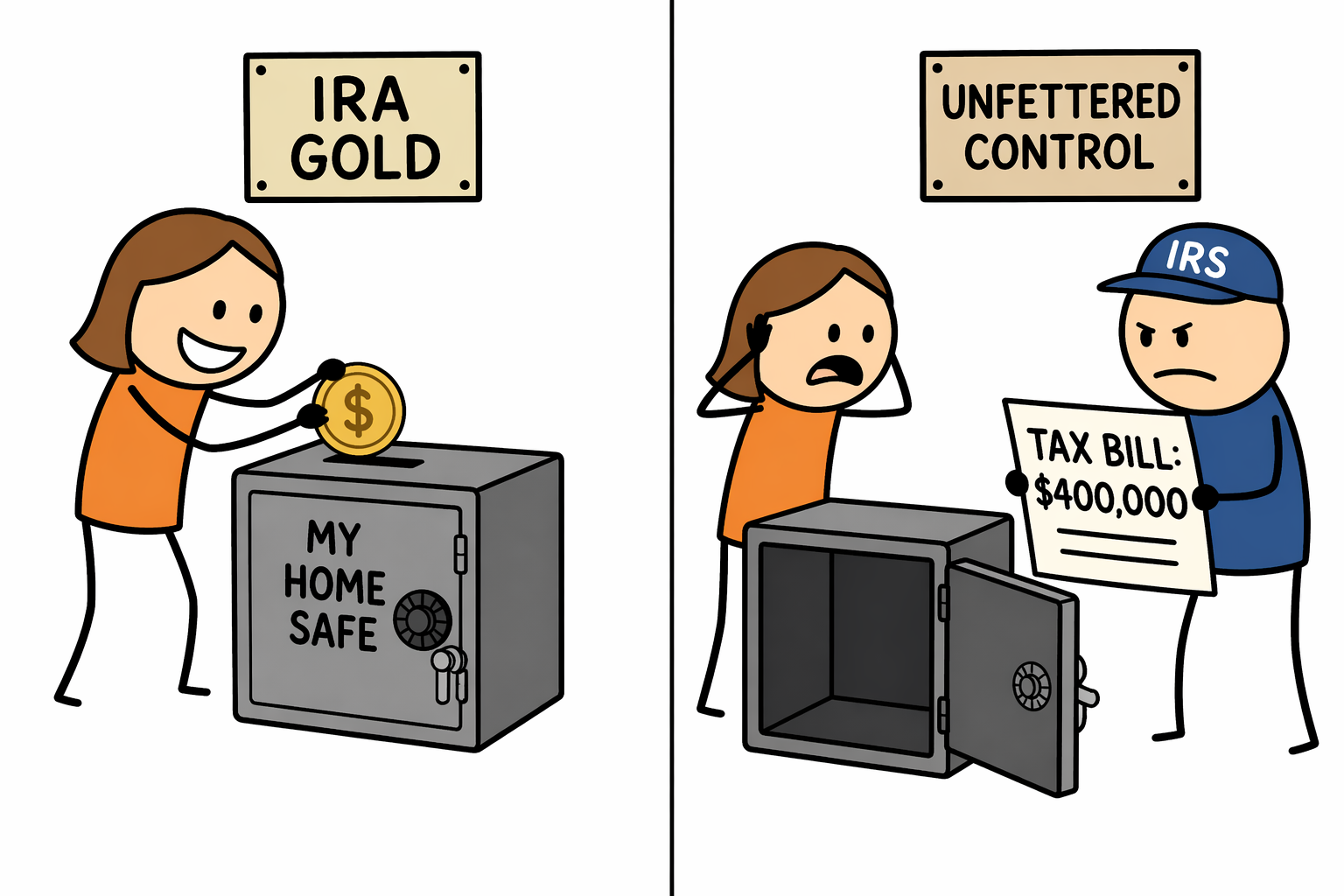
In McNulty v. Commissioner (2021), a woman used a Self-Directed IRA to buy gold coins. She followed a website's advice that told her she could store the gold in a safe at her house if she used an LLC as the intermediary. The IRS argued that because she had unfettered control over the gold (she had the keys to the safe), she had effectively taken a distribution of the entire IRA. The Tax Court agreed. Her entire $400,000 IRA was deemed distributed in a single year. She owed six figures in income taxes and was hit with early withdrawal penalties on top. The case is the ultimate reminder that in the retirement world, possession is not nine-tenths of the law. It is ten-tenths of a taxable event. If you can touch it, open it, or access it without going through a custodian, the IRS considers it distributed.
The Custodian Difference
Traditional Custodians (Schwab, Fidelity, Vanguard)
These custodians limit your investment options to publicly traded securities: stocks, bonds, mutual funds, ETFs, CDs. They don't support real estate, private placements, or other alternative investments.
In exchange, you get low fees (often zero account fees), easy online access, and a familiar interface. For the vast majority of IRA owners, these custodians are the right choice.
Self-Directed IRA Custodians
These are specialty custodians that support alternative investments. They hold the assets, process transactions, and handle IRS reporting. Some well-known self-directed IRA custodians include Equity Trust, The Entrust Group, IRA Financial, Madison Trust, and Alto IRA.
The custodian does not give investment advice. They do not vet your investments. They do not tell you whether a deal is good or bad. They process paperwork. The investment decision is entirely yours.
What You're Paying For
Self-directed IRA custodians charge fees that traditional custodians don't. Common fees include:
- Annual account maintenance fees ($50–$300+)
- Transaction fees (per investment purchase or sale)
- Asset-based fees (percentage of account value)
- Wire transfer fees
- Real estate-specific fees (property holding, rental income processing)
These fees can add up quickly, especially with real estate. Understand the full fee schedule before opening an account. A $200 annual fee on a $500,000 account is negligible. A $200 annual fee on a $15,000 account is eating your returns.
The Custodian Doesn't Protect You
If you invest in a fraudulent real estate deal, the custodian bears no responsibility. If you commit a prohibited transaction, the custodian didn't catch it for you. The responsibility for compliance and due diligence is entirely on you.
The Checkbook IRA (IRA LLC)
The Checkbook IRA is a structure within a self-directed IRA that gives you direct control over the IRA's investment transactions without going through the custodian for every purchase and payment.
How It Works
- You open a self-directed IRA at a specialty custodian.
- The IRA forms a single-member LLC (the IRA is the sole member).
- The LLC opens a checking account at a bank.
- You are appointed as the manager of the LLC.
- The IRA funds the LLC, and the money lands in the LLC's checking account.
- You write checks and make investments directly from the LLC's account.
Instead of calling your custodian every time you want to buy a property, fund a loan, or pay an expense, you just write a check. The custodian is still the IRA's trustee, but the day-to-day transactions happen through the LLC.
Why People Use It
Speed. Real estate deals move fast. If you need to submit earnest money by Friday, you can't wait for a custodian to process the transaction next week. The checkbook gives you immediate access.
Control. You manage the LLC's bank account directly, pay property taxes, insurance, and maintenance expenses without submitting paperwork to the custodian each time.
Lower transaction fees. Because the custodian isn't processing each individual transaction, you may save on per-transaction fees. You'll typically pay a higher setup fee and ongoing LLC maintenance costs instead.
The Risks
Prohibited transactions are easier to commit. With a checkbook at your fingertips, the temptation to use IRA funds for personal expenses or transactions with disqualified persons increases. There's no custodian review step to slow you down.
LLC compliance. The LLC must file state annual reports, maintain good standing, and pay state fees. If the LLC falls out of good standing, it could create problems for the IRA.
Valuation complexity. You're responsible for providing fair market valuations of the LLC's assets to the custodian annually for Form 5498 reporting. For real estate and private investments, that's not always straightforward.
The Same Rules Apply
UBTI and UDFI
Most IRA income is tax-exempt. But there are two situations where your self-directed IRA can owe taxes.
Unrelated Business Taxable Income (UBTI)
If your IRA invests in an active trade or business (not passive investment income like rent or dividends), the income may be subject to UBTI. This most commonly applies when the IRA owns an interest in a partnership or LLC that operates a business.
UBTI is taxed at trust tax rates, which are compressed. The top 37% rate kicks in at roughly $16,250 of taxable income for 2026.
If UBTI exceeds $1,000 in a year, the IRA must file Form 990-T and pay the tax. The tax is paid from the IRA's funds, not from your personal accounts.
Unrelated Debt-Financed Income (UDFI)
If your IRA uses debt (a mortgage) to purchase an asset, a proportional share of the income from that asset is subject to UDFI. This commonly applies to IRA-owned real estate purchased with a non-recourse loan.
Non-recourse loans are required for IRA real estate purchases. The IRA owner cannot personally guarantee the loan. If the borrower (the IRA) defaults, the lender's only recourse is the property itself.
Valuation Requirements
If your self-directed IRA holds alternative investments, you must provide a fair market valuation of those assets to the custodian each year. The custodian reports this on Form 5498.
For publicly traded securities, valuation is automatic. The price is on the screen.
For real estate, private equity, promissory notes, and other illiquid investments, you need an independent appraisal or a reasonable method of determining fair market value. The IRS doesn't specify how to value every asset, but it does require the valuation to be reasonable.
Common Scams and Red Flags
The self-directed IRA space attracts legitimate investors and fraudsters in roughly equal measure. The lack of custodian oversight means you're the last line of defense.
Guaranteed Returns
No legitimate investment guarantees a return. If someone promises a fixed 12% annual return on a real estate deal or a private placement, that's a red flag.
Pressure to Act Immediately
Legitimate deals don't disappear in 48 hours. If a promoter is pressuring you to wire IRA funds immediately, slow down.
"The Custodian Reviewed It"
No, they didn't. Self-directed IRA custodians process paperwork. They don't evaluate investments. If a promoter tells you the custodian approved the investment, they're lying.
Unclear or Absent Documentation
Any investment your IRA makes should come with proper legal documentation: operating agreements, subscription documents, promissory notes, title work, property inspections. If the documentation is vague or nonexistent, walk away.
Too Good to Be True
This applies to all investing, but it's amplified in the self-directed IRA space because investors are often less experienced with alternative assets. Due diligence is your responsibility. Get independent legal and financial advice before committing IRA funds to any alternative investment.
Common Mistakes
Committing a Prohibited Transaction
The most expensive mistake. Using IRA funds to benefit yourself or a disqualified person disqualifies the entire IRA. The full balance becomes taxable, plus penalties if you're under 59½.
Not Understanding UBTI/UDFI
Buying leveraged real estate in your IRA without accounting for UDFI can create an unexpected tax bill. The IRA owes the tax, not you personally, but it reduces the account balance.
Skipping Due Diligence
The custodian won't protect you from bad investments. Research every deal independently. Verify the people, the property, the documents, and the numbers.
Storing Precious Metals at Home
IRS-approved precious metals must be held by an approved depository, not in your safe or your closet. Storing them at home is a distribution, which means income tax and potentially the 10% penalty.
Personally Guaranteeing an IRA Loan
If your IRA borrows money (for real estate, for example), the loan must be non-recourse. You cannot personally guarantee it. A personal guarantee is a prohibited transaction.
Performing Sweat Equity on IRA Property
You can't paint the walls, fix the plumbing, or mow the lawn at a property your IRA owns. That's providing services to the IRA, which is a prohibited transaction. All maintenance and improvements must be done by unrelated third parties, paid from IRA funds.
Mixing IRA and Personal Funds
All income from IRA investments goes back into the IRA. All expenses for IRA investments are paid from the IRA. You can't deposit rental income into your personal account or pay property taxes from your personal checking account. Every dollar flows through the IRA.
Self-Directed IRA Still Follows the Same Rules
Contribution limits, RMDs, and Roth conversion rules apply to self-directed IRAs just like any other. Use these tools to check the math.
All tools include step-by-step explanations. See pricing →
FAQ
Is a self-directed IRA a different type of account?
No. It's a Traditional or Roth IRA held at a custodian that supports alternative investments. The tax rules, contribution limits, and withdrawal rules are identical to any other IRA.
Can I invest in real estate with my IRA?
Yes. Your IRA can purchase residential or commercial property, raw land, and even foreign real estate. All income and expenses must flow through the IRA, and you can't use the property personally.
Can I buy cryptocurrency in a self-directed IRA?
Yes. Some self-directed IRA custodians support cryptocurrency investments. The crypto is held in the IRA and follows standard IRA tax treatment.
Can I invest in my own business with my IRA?
Generally no. If you own 50% or more of the business, it's a disqualified entity, your IRA can't transact with it. If you own less than 50% and the transaction doesn't provide you with indirect personal benefit, it may be permissible, but proceed with extreme caution and get legal advice.
What's the difference between a self-directed IRA and a Checkbook IRA?
A Checkbook IRA is a self-directed IRA where the IRA owns an LLC, and you manage the LLC's checking account. It gives you direct transactional control without routing every purchase through the custodian. The same IRS rules apply to both structures.
Do I need a special custodian?
Yes, if you want to invest in alternative assets. Traditional custodians like Schwab and Fidelity don't support real estate or private placements. You'll need a specialty custodian that handles alternative investments.
How much does a self-directed IRA cost?
Fees vary widely. Expect annual account fees of $50–$300+, plus transaction fees, asset-based fees, and potentially real estate-specific fees. Compare fee schedules across custodians before committing.
Can I contribute more to a self-directed IRA than a regular IRA?
No. The contribution limits are the same: $7,500 for 2026 ($8,600 if 50+). The account type doesn't change the limits. However, you can roll over unlimited amounts from 401(k)s or other IRAs into a self-directed IRA.
What happens if I accidentally commit a prohibited transaction?
The IRA is disqualified as of January 1 of the year the transaction occurred. The entire balance is treated as a taxable distribution. If you're under 59½, the 10% penalty applies. There's no "oops" provision, this is why understanding the rules before investing is critical.
Is a self-directed IRA riskier than a regular IRA?
The account itself isn't riskier. The investments might be. Alternative investments like real estate, private equity, and promissory notes are illiquid, harder to value, and carry risks that publicly traded securities don't. The custodian won't evaluate your investments for you, due diligence is entirely your responsibility.
Can I roll my existing IRA into a self-directed IRA?
Yes. A direct trustee-to-trustee transfer from any IRA to a self-directed IRA is straightforward. You can also roll over from a 401(k) or other employer plan. Standard rollover rules apply, see our Rollover IRA guide for the details.
Should I use a self-directed IRA?
Only if you have specific expertise in alternative investments and are willing to do your own due diligence. If you don't understand real estate investing, private lending, or whatever alternative asset you're considering, a self-directed IRA adds risk without adding value. The flexibility is only useful if you know how to use it responsibly.
Related Knowledge Blasts
Short, plain-English breakdowns of the rules behind this guide:
- Why Custodians Don't Stop You →
- Required Minimum Distribution Penalty Relief →
- Rollover vs. Transfer: They Are NOT the Same Thing →
- The 60-Day Rollover Rule: Why It's Almost Never Worth the Risk →
- Contribution Limits vs. Income Limits vs. Compensation Limits →
- Excess Contribution Removal: What to Do Before the Deadline →
Primary IRS sources
Every rule, limit, deadline, and form number on this page traces back to the official IRS references below. Links open on irs.gov.
IRS Publication 590-A, Contributions to Individual Retirement Arrangements (IRAs)
IRS: Retirement topics, prohibited transactions
Education-only disclaimer
This guide is for general education and information only. It does not provide individualized investment, tax, or legal advice, and does not establish a client relationship with any firm or individual. Always consult your own tax professional, financial advisor, or legal counsel before making decisions about your accounts, investments, or retirement strategy.
Get the retirement rule mistakes most people learn too late
Daily: one retirement rule trap, why it happens, and the fix. Everyday-language IRS rule breakdowns from an 8-year Schwab/TD Ameritrade veteran. Free.
Join the Rundown: Free